

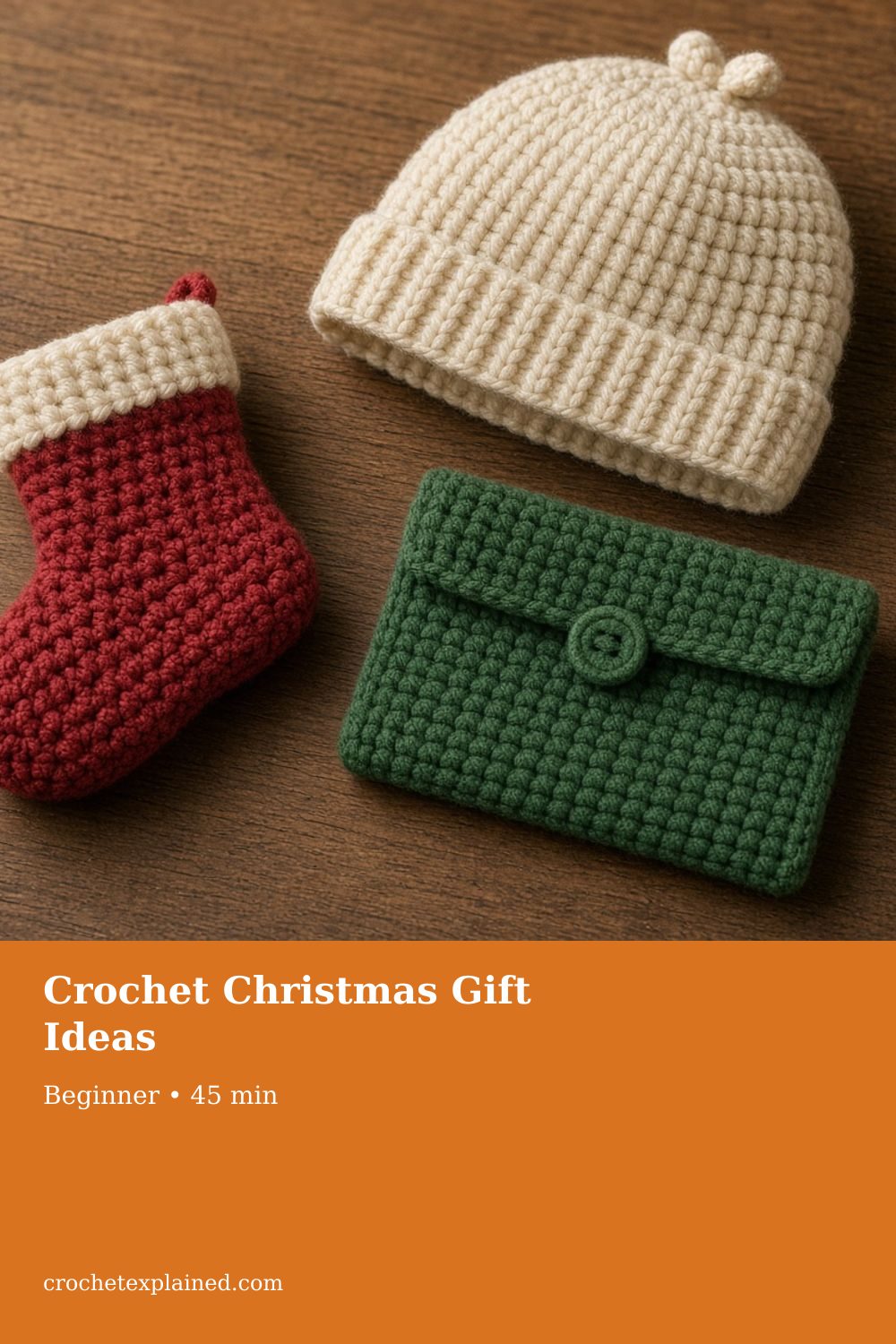
Crochet Christmas Gift Ideas
Pick a Christmas gift from a tutorial already on this site, sorted by how long it takes and who it is for.
Christmas gifts you can crochet from tutorials already on this site, sorted by how long they take and who they are for.
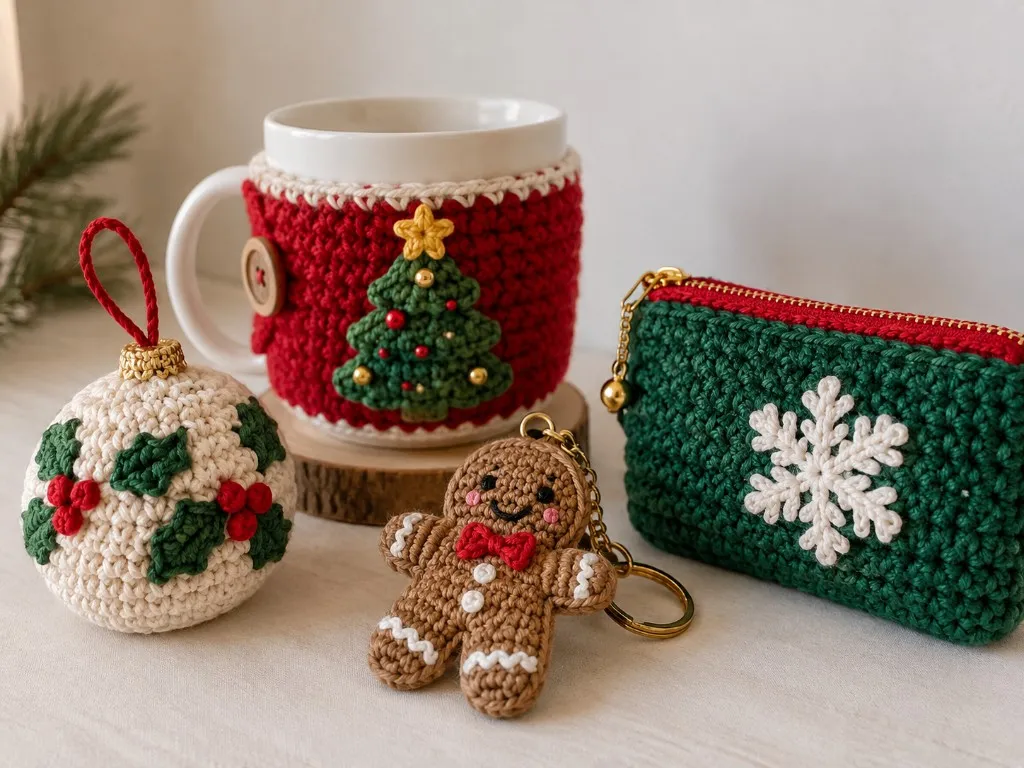
On this page
- If you have one evening
- If you have a weekend
- If you are starting in October
- People who do not want another hat
- Sizing a gift without asking
- Put a care card in the box
- What not to promise
- Choose a tutorial you can size and finish
- Use this page to choose, then leave it
- Put the gift on a calendar
- One evening: choose, measure, and finish each small gift
- A weekend: measure first, then the bulky or the fitted piece
- From October: long pieces and pieces with parts
- People who do not want another hat
- Measure without asking
- Finish so it can be wrapped
- What not to promise, and what not to stack
- Read the linked page once before you buy anything
- When the plan slips, switch on purpose
- Which finishing method belongs to which gift
- The morning you wrap
- Pairs that stay one gift, and piles that become three
- Buy yarn after you know the tutorial, not before
- A single gift, followed all the way to the box
- Frequently asked
The useful Christmas question is not what you can invent in December. It is which finished object you can actually complete before the date on the calendar.
Every project below already has a tutorial on this site. Yarn that behaves in small holiday stitches is covered in yarn for Christmas crochet.
This is a guide to existing tutorials rather than a new pattern. Pick the project you can finish, not the one with the newest date.
If you have one evening
- Christmas gift card holder. A flat pocket. One of the few gifts that is finished when the sewing is done.
- Mug cozy. Measure the mug first or it will not close.
- Snowflake. Three rounds, then stiffening. Allow a day for it to dry hard.
- Scrunchie. Sized from a hair elastic, so you do not need the person’s measurements.
- Simple flower. Sew it to a plain gift or to the mug cozy.
- Fall leaf. A small appliqué. The stitch count is on paper, not from a finished leaf.
- Halloween coasters. A flat pumpkin disc, plus a granny set. Not a hot pad.
The ornament page is a menu
- The ornament ideas page lists fifteen shapes and writes one flat star in full.
- Use that star if you want a written pattern.
- Use the links on that page for the tree and the snowflake.
- Fifteen ideas are a menu. One finished star is a gift.
If you have a weekend
- Chunky beanie. Bulky yarn finishes faster than worsted. Measure the head.
- Ear warmer. A good gift when you do not know the hat size.
- Fingerless gloves. Measure the hand first. With the thumb gap opposite the round join, both gloves are worked the same.
- Book or e-reader sleeve. Measure the device. The same folded shape fits many e-readers if you measure it instead of guessing a brand size.
- Wine bottle bag. The bottle is the form. Crochet to that bottle.
If you are starting in October
- Gnome. Four small pieces. The hat length is what makes it read as a gnome.
- Christmas tree. A cone, not a blanket.
- Beginner scarf. One stitch, repeated. Swatch before you trust the width.
- Hooded scarf. Long. Start it before December.
- Baby blanket. A plain rectangle. Wash a swatch before you buy all the yarn. No buttons and no appliqués.
- Slippers. A sole that is pure yarn is slippery on wood floors. Read the finishing notes before you gift them.
People who do not want another hat
- Drawstring bag if Halloween yarn is still out, or the makeup pouch and pumpkin zipper pouch.
- Laptop sleeve or phone case only if you can measure the device. A guessed phone size is a gift that does not fit. A phone with a strap is the phone crossbody.
- Market bag for someone who actually carries one.
- Bowl cozy only if you read the heat section first. It is cotton, it is not a hot pad, and it does not claim to be microwave-safe.
Sizing a gift without asking
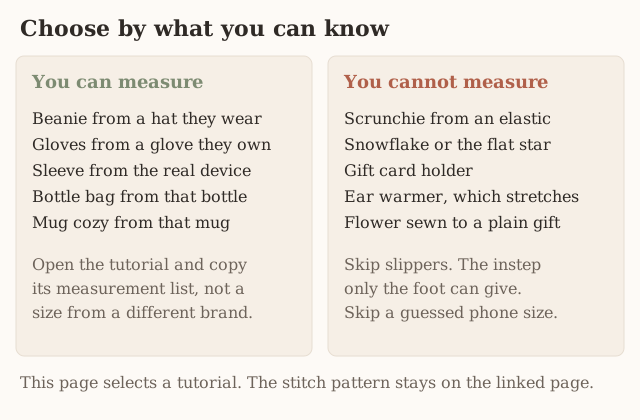
Half the projects above need a measurement, and asking spoils the surprise. Measure something the person already owns instead.
A hat they wear
- Lay it flat.
- Measure across the brim, and double it.
- That is the hat’s relaxed size, which already includes the ease they like.
- Use it as the target in the chunky beanie.
A phone or e-reader
- Measure the device in the case they use, because that is what has to fit.
- The phone case explains why thickness matters as much as width.
Gloves
- Measure around the palm of a glove that fits them, lying flat, and double it.
- Take that number to the glove tutorial. Do not guess a hand you have not seen.
Slippers or shoes
- Measure the inside length of a shoe they wear, heel to toe.
- That is close to the foot length, though a shoe usually has a little extra room.
- Slippers also need a measurement over the top of the foot, which only the foot can give, so they are hard to make as a surprise.
If you cannot measure anything, pick a project that does not need it: the scrunchie, an ornament, the gift card holder, or the ear warmer, which has some stretch.
Put a care card in the box
A crochet gift is easy to ruin in its first wash. Write a small card with three facts and tuck it in.
The three facts
- The fiber, copied from the yarn label: acrylic, cotton, wool, or a blend.
- How to wash it. Copy the label’s symbols or write them out. Hand wash and dry flat is the safe default for anything with stuffing or stiffener.
- What it is not. A cotton cozy is not a hot pad. Slippers slide on hard floors. A stiffened ornament dissolves if it gets wet. Say so on the card, because the person opening it did not read the tutorial.
Keep the ball band yourself, pinned to a leftover length of yarn, so you can repair the gift later in the same yarn.
What not to promise
- Do not tell someone a project is done when the ends are still hanging out.
- Weaving ends is part of the gift.
- Do not stuff a new amigurumi pattern into the same week as a blanket.
- The Santa tutorial is a technique page for that shape, separate from the gnome.
Choose a tutorial you can size and finish
Read the linked page before you buy
- Open the linked pattern before buying yarn.
- Write down its required skills, measurements, accessories, and drying time.
- For a hat, ear warmer, or gloves, obtain a measurement or a suitable reference item.
- Stretch does not remove the need to size the gift.
- Time one repeat or ten rows in your own yarn.
- Estimate the remaining crochet, then add assembly, end-weaving, and any blocking or stiffener drying.
- An ornament that needs to dry overnight is not ready when the last stitch is made.
- This page is a project selector. The full instructions are on the linked pages.
Use this page to choose, then leave it
The counts live on the linked page
- Every project named here already has its own tutorial.
- This page does not add a new stitch pattern, a new gnome, or a new scarf.
- If a sentence below sounds like a count you should copy into a notebook as the pattern, stop and open the link.
- The counts live there.
- What lives here is the decision: which tutorial you can finish, what you must measure before you buy yarn, how to put it on a calendar, and what finished means after the last stitch.
Four lines, then your own speed
- Open the linked page before you buy yarn.
- Write four lines from it: the skills it assumes, the measurements it asks for, the notions that are not yarn, and any drying or washing time.
- A snowflake that needs a day to stiffen is not an evening gift on December 24 if you start it that night.
- A baby blanket that asks you to wash a swatch is not a same-day project, because the swatch has to dry before you trust the size and buy the rest of the yarn.
- Then time your own hands. Work ten rows, or one repeat, in the yarn you will use. Note the minutes.
- Multiply by how many of those units the linked page contains, and add assembly, end-weaving, and drying.
- That product is a planning estimate from your speed, not a promise printed on this site.
- If the estimate does not fit the days you have, pick a smaller tutorial.
- Do not keep the large one and skip weaving the ends.
Yarn that behaves in small holiday stitches is covered in yarn for Christmas crochet. The short version, so you can choose a project before you choose a fiber: worsted acrylic for stuffed pieces, cotton or crochet thread when the piece has to hold a blocked shape, metallic yarn only as a short accent, and no crochet next to a lit candle. A metallic strand that looks festive in the shop is harder to see stitches in, and it is a poor choice for the first project of December.
Put the gift on a calendar
Count backward from the handoff
- Write the date you will hand the gift over.
- Count backward.
- Put drying on the calendar as its own day if the tutorial uses stiffener or asks you to wash a swatch.
- Put weaving ends on the calendar as its own block if the piece is long.
- A scarf with a tail every row is not finished when the last row is worked.
- Weaving in ends is part of the gift.
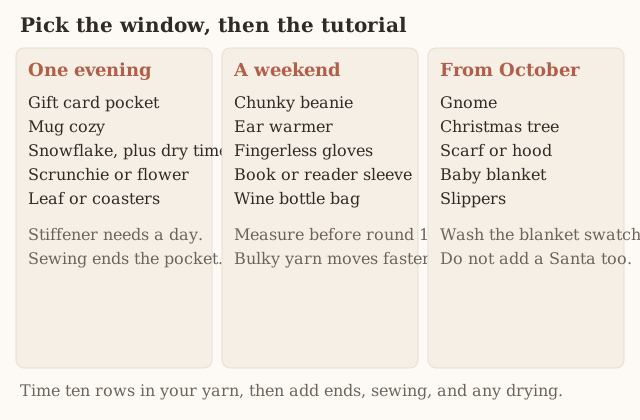
- Use three windows, and do not promote a project into a smaller window because you like it.
One evening
- One evening means the crochet and the sewing can happen in one sitting.
- You still check the next morning only if something has to dry.
- The gift card holder is in this window because it is finished when the sewing is done.
- The snowflake is in this window for the crochet and out of it for the stiffener.
- Start the snowflake on an evening when the next day is free.
A weekend
- A weekend means you can measure, swatch, and finish a bulky or a small fitted piece, with ends woven before Monday.
- A chunky beanie fits this window more easily than a worsted scarf because bulky yarn finishes faster.
- It still needs a head measurement before round one.
- Do not start it on Sunday night.
From October
- From October means the piece is long, or it has several parts, or it needs a washed swatch, or it is easy to underestimate.
- The hooded scarf, the baby blanket, the gnome, the tree, and the slippers belong here.
- Starting them in the second week of December is how they become unfinished gifts with a bow on the work in progress.
Do not put the Santa tutorial in the same week as a blanket. Santa is a technique page for that shape, separate from the gnome. Two stuffed pieces plus a large rectangle is three projects. Pick one.
| Window | What can finish | What still needs another day |
|---|---|---|
| One evening | Gift card holder, once the sewing is done | Snowflake stiffener. Crochet can be that evening. Drying is the next day |
| A weekend | Beanie, ear warmer, gloves, sleeve, bottle bag, ends woven before Monday | A head or object measurement before round one. Do not start Sunday night |
| From October | Gnome, tree, scarf, hood, blanket, slippers | Washed swatch, several parts, or a long rectangle. December starts are how these stay unfinished |
One evening: choose, measure, and finish each small gift
Gift card holder
- Choose this when the person is hard to size and you still want the gift to be crochet rather than only a card in an envelope.
- The linked tutorial is a flat pocket for one ID-1 card, 3.370 by 2.125 inches, folded off center so the card stays easy to pull out.
- You do not need their hand size.
- You need a gift card of that standard size, which is the same size as a bank card.
- Measure the card you will enclose if you are unsure it is ID-1.
- Work the pocket from that tutorial, sew it as that page describes, and weave the ends.
- It is finished when a card slides in and comes out without catching a tail.
- There is no stiffener and no overnight wait.
Mug cozy
- Choose this when you can borrow the mug or an identical one.
- The tutorial is a strip worked sideways, with a loop that passes inside the handle and one button.
- If you guess the mug from memory, the strip will not meet.
- Measure the height you want covered and the distance around.
- Take the handle into account the way that page tells you, because the loop has to pass inside the handle rather than sit on top of it.
- Finish by sewing the button where the closed strip lands on that mug, not where it landed on a water glass you used as a stand-in.
- A flower from the flower tutorial can be sewn on after the button is placed, so the flower does not cover the buttonhole or the loop.
Snowflake
- Choose this when you want a tree ornament and you can give it a day to dry.
- This page’s note is three rounds, then stiffening.
- The tutorial builds a six-point snowflake from a center ring and then stiffens and blocks it so it hangs flat instead of curling.
- Schedule the crochet on one evening and the drying as the next step on the calendar.
- It is not finished when the last stitch is fastened.
- It is finished when it is dry, flat, and has a hanger that will not pull out.
- Keep it away from a lit candle, as the yarn page says for any crochet.
- A stiffened piece softens if it gets wet. Say that on the care card.
Scrunchie
- Choose this when you do not know a clothing size.
- The tutorial sizes the strip from a hair elastic, about twice the elastic’s length, then seams the strip around the elastic and gathers it.
- Buy or borrow the elastic first.
- Do not crochet a strip and hope an elastic from a drawer will match.
- Finish by checking that the elastic still stretches after the seam, and that the seam is not a lump that will sit against the head.
- Weave the ends into the gathered fabric so they do not poke.
Simple flower
- Choose this as an add-on, not as the only gift, unless you are sewing it to a wrapped present the person already wants.
- The tutorial is a flat five-petal flower.
- It includes a leaf made in one pass down a chain.
- Sew it to the mug cozy or to a plain gift.
- Do not sew it over a button, a loop, or a drawstring.
- Finish means the sewing thread is secure and the flower lies flat.
- A flower with a loose center will come off in a bag.
Fall leaf
- Choose this when you want a small appliqué and you have read that the stitch count is on paper, not from a finished leaf.
- The tutorial works the leaf around both sides of a chain and shapes it by stitch height, in two sizes.
- Pick one size before you chain, and follow that size’s counts on that page.
- Do not average them.
- Finish by sewing it to something that can take a few stitches: a plain gift bag, the corner of a scarf you already made from the scarf tutorial, or a card.
- Do not sew it to a stretchy hat brim if you have not checked that the leaf buckles when the brim stretches.
Halloween coasters
- They are on this list because a flat pumpkin disc and a granny set are fast, and because December still has people who want something for a table.
- They are not a hot pad.
- Choose them when a coaster is actually useful, and say on the care card that they are not for a hot pan.
- The tutorial keeps the disc flat with its own increase plan.
- If your disc bowls or ruffles, follow that page’s fix.
- Do not add rounds until it looks big enough and then gift a warped circle.
- Finish by weaving ends and laying the set flat.
- A coaster that curls will not sit under a glass.
Ornaments page
- The ornament ideas page lists fifteen shapes and writes one flat star in full.
- Use that star if you want a written pattern tonight.
- Use the links on that page for a tree or a snowflake rather than inventing either one here.
- Choose the star when you want one hanging gift with counts already written.
- Measure nothing on a body.
- Do plan a hanger and, if you stiffen it, a drying day.
- Fifteen ideas are a menu. One finished star is a gift.
- Do not start three shapes on December 23.
| Evening gift | What you must have first | Finished means |
|---|---|---|
| Gift card holder | An ID-1 card, 3.370 by 2.125 in | Card slides in and out, ends woven. No overnight wait |
| Mug cozy | The real mug, handle included | Button lands on that mug. Loop passes inside the handle |
| Snowflake | A free day after the three rounds | Dry, flat, hanger will not pull out |
| Scrunchie | The hair elastic, before you chain | Elastic still stretches. Seam is not a lump |
| Flower or leaf | Something to sew it to | Thread secure, clear of buttons, loops, and drawstrings |
| Coasters | A table use, and the care-card limit | Flat set. Not a hot pad |
A weekend: measure first, then the bulky or the fitted piece
Chunky beanie
- Choose this when you can measure a head or a hat they already wear, and when you can use bulky yarn so the weekend is enough.
- The tutorial uses a sideways ribbed brim and shows how to pick up the body evenly so the hat does not flare.
- Lay their hat flat, measure across the brim, and double it.
- That is the relaxed size, including the ease they already like.
- Take that number to the beanie page and use it as the target.
- Do not start the brim at a random chain and try it on if they are the person you are hiding the gift from.
- Finish by weaving the brim’s ends and checking that the pick-up did not flare.
- A flared first inch will not block out into a fitted hat.
- Blocking is not a resize.
Ear warmer
- Choose this when you do not know the hat size and you still want something for a head.
- The tutorial is a ribbed band.
- The chain is the width and the rows are the circumference.
- You still size it from a head, but the stretch of ribbing forgives more than a fitted beanie does.
- If you cannot measure anything, this is the headwear option this page allows, not the beanie.
- Finish when the band meets in a join that does not twist, and when it slides on without a gap at the back.
- A twisted join is a new row, not a tug.
Fingerless gloves
- Choose this when you can measure a hand or a glove that fits, and when you can make two the same way.
- The tutorial sizes from the wrist, the knuckles, and the thumb.
- This page’s rule is the one to keep while you follow those counts: measure first, and with the thumb gap opposite the round join, both gloves are worked the same.
- You do not mirror a second glove into a different pattern.
- Lay a glove that fits them flat, measure across the palm, and double it.
- Then open the glove tutorial and use its wrist, knuckle, and thumb measurements as far as you can take them from that owned glove.
- If the owned glove will not give you the thumb length, do not guess.
- Switch to an ear warmer or a scrunchie.
- Finish by weaving ends on both gloves and checking that the thumb gap is opposite the join on each.
- A gap that drifted toward the join will sit in the wrong place on the hand.
Book or e-reader sleeve
- The device case tutorial is one method per shape: a folded flat sleeve for a laptop, a book, or a tablet, or a round pouch for something small.
- For a weekend gift, choose the flat sleeve and only if you can measure the device, ideally in the case they already use.
- Width and thickness both matter.
- A sleeve planned from a bare tablet will not take that tablet in a thick case.
- Write the measurements down before you chain.
- Finish when the device slides in with the case on, the fold does not gap at the sides, and the ends are woven.
- A sleeve that only fits the bare device is not the gift you measured for.
Wine bottle bag
- Choose this when you have the bottle.
- The tutorial uses that bottle as the form: base, sides, and cord planned from it, with a handle so you never lift the bottle by the cord.
- Do not substitute a similar bottle from the shop if the one you will give is a different shape.
- Finish by putting the real bottle in, closing the drawstring, and lifting by the handle.
- If the only way to carry it is the cord, the handle is not finished.
- Weave the ends so they cannot fall into the bottle neck.
Measure before the first chain on every weekend project. A beanie without a doubled brim number, gloves without a palm, a sleeve without thickness, and a bottle bag without that bottle are guesses. A guess is a gift that does not fit.
From October: long pieces and pieces with parts
Gnome
- Choose this when you can start early and you want a stuffed figure rather than a garment.
- The tutorial is four pieces: a body worked from the top down to a flat base, a tall hat, a nose, and a beard.
- The hat length is what makes it read as a gnome, and on that page the hat comes down to the nose.
- The base is weighted before it is closed.
- Schedule the body, the hat, the nose, and the beard as separate sittings if your ten-row timing says one sitting will not hold.
- Finish means the weight is in, the opening is closed, the hat sits at the length that page describes, and there are no loose ends a child could pull.
- Do not add buttons or plastic eyes that can come off.
- Follow that page for how the face is made.
- This page is not a second gnome pattern.
Christmas tree
- Choose a tree when you want a decoration and you have read that it is a cone, not a blanket.
- The tutorial includes a standing cone worked from the tip, a flat triangle, and stacked rounds.
- Pick one of those three before you chain, and follow that shape’s counts on that page.
- A standing tree needs a flat base and weight if that page calls for them, or it will not stand.
- A flat triangle is the one to choose if you want an ornament rather than a table piece.
- Do not start the cone and switch to the triangle in the same yarn without reading the second set of counts.
- Finish the standing one only when it stands on its own.
- Finish the flat one when it lies flat and has a hanger.
Beginner scarf
- Choose this when the person will actually wear a scarf and you can start with enough time to swatch.
- The tutorial plans a half double crochet scarf from your swatch.
- Width is the stitch count. Length is the rows.
- Swatch before you trust the width.
- If the swatch is wider than you thought, a scarf at the same tension will be heavier and longer in yarn than you bought.
- Buy after the swatch, not before.
- Finish by weaving every end.
- A long scarf with a tail at each color change is not done.
- Block only if the weaving-ends page’s reasons apply.
- Blocking will not turn a too-narrow swatch into the width you wanted.
Hooded scarf
- Choose this only if October is still honest.
- The tutorial explains how a hood is folded from a rectangle, and a 12-inch panel will not fit an adult head.
- Read that limit before you chain.
- Measure, or follow that page’s adult dimensions, and do not shrink the panel to save yarn.
- This is a long project. Put it on the calendar in weeks, not in evenings.
- Finish when the hood fold matches that page, the scarf ends are even, and the ends are woven.
- A hood that is short because the panel was shortened will not become a hood in the wash.
Baby blanket
- Choose this when you can wash a swatch and wait for it to dry before you buy the rest of the yarn.
- The tutorial is a plain half double crochet rectangle from that washed swatch.
- No buttons and no appliqués.
- A baby blanket with buttons or ties is a hazard, which is why this page says no.
- Finish when the rectangle is the size the washed gauge predicts, the ends are woven, and the care card copies the yarn label.
- Do not sew on the fall leaf, the flower, or a gnome.
- Plain is the gift.
Slippers
- Choose these only if you can measure the foot, including over the top of the foot, or if you accept that they are hard to make as a surprise.
- The tutorial is a sole, a toe cap wide enough to go over the toes, and a heel wall.
- A sole that is pure yarn is slippery on wood floors.
- Read the finishing notes on that page before you gift them, and put the slip warning on the care card.
- Inside shoe length, heel to toe, is close to foot length, with a little extra room in the shoe.
- It does not replace the instep measurement.
- If you cannot get the instep, pick another gift.
- Finish when both slippers match and the sole warning is written down.
- Do not promise they are safe on stairs or on a hard floor.
| October project | Parts or limit already on its page | Do not gift it when |
|---|---|---|
| Gnome | Four pieces. Hat comes down to the nose. Base weighted before it is closed | Loose ends, buttons, or plastic eyes a child could pull off |
| Tree | Standing cone, flat triangle, or stacked rounds. Pick one | The standing tree will not stand, or the flat one has no hanger |
| Scarf | Half double crochet from your swatch | Ends still hanging at each color change |
| Hooded scarf | A 12-inch panel will not fit an adult head | The panel was shortened to save yarn |
| Baby blanket | Plain half double crochet from a washed swatch | Buttons, ties, a leaf, a flower, or a gnome sewn on |
| Slippers | Sole, toe cap, heel wall. Instep only the foot can give | No instep measurement, or no slip warning on the card |
People who do not want another hat
A hat is the default crochet gift, and a lot of people already own one. Choose from this list when the person has said so, or when you have never seen them in a hat.
Drawstring bag, makeup pouch, or pumpkin zipper pouch
- The drawstring bag is the round-base method, including a cord through an eyelet round.
- Use it if Halloween yarn is still out and a small bag is welcome.
- The makeup pouch is sized from the widest, thickest, and tallest things that person carries, so you need to know those objects or to ask.
- The pumpkin zipper pouch adds a hand-sewn zipper on a round opening and a stem.
- A zipper is a notion you buy before the last round, not after, because the opening and the zipper tape have to agree.
- Finish a drawstring by testing the cord.
- Finish a zipper by opening and closing it with the pouch empty and then with the things it was sized for.
- A zipper sewn into a round opening that puckers will not improve in the wash.
Laptop sleeve, phone case, or phone crossbody
- All three need a measurement.
- The laptop or tablet sleeve is the folded shape in the device case tutorial.
- The phone case explains why thickness matters as much as width.
- Measure the phone in the case they use.
- Do not copy a brand example from that page onto a different phone.
- A guessed phone size is a gift that does not fit.
- A phone with a strap is the phone crossbody.
- That page sizes the strap, attaches it so it holds, and fits it after it stretches.
- A strap that was the right length on the evening you sewed it can grow.
- Check the length after it has hung, before you wrap it.
- Finish when the device goes in and the strap, if there is one, still holds with the device inside.
Market bag
- Choose this only for someone who carries one.
- The tutorial is cotton, with a solid single-crochet base, mesh sides, a firm band, and handles placed by count.
- It is not load-rated.
- Do not promise it will carry groceries of any weight.
- Finish by weaving ends at the handles, where a loose tail is both ugly and weak, and by writing on the care card that the bag is cotton and not a rated tote.
- If you do not know whether they would use a market bag, make a scrunchie.
Bowl cozy
- Choose this only after you read the heat section on the bowl cozy page.
- It is a two-layer cotton cozy planned from your bowl.
- It is not a hot pad.
- It does not claim to be microwave-safe.
- Do not microwave it.
- Measure the bowl you will give it with, or an identical bowl.
- Finish when it sits on that bowl, the two layers are secure, and the care card says it is not a hot pad and not for the microwave.
- A cozy gifted with a cheerful note about reheating soup is a dangerous note.
- Write the limit instead.
Measure without asking
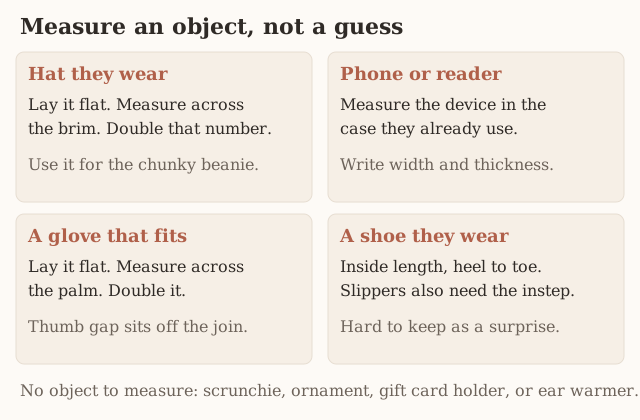
Half the projects need a number, and asking spoils the surprise. Measure an object they already use. Write the number on paper. Do not hold it in your head until you are at the hook.
A hat they wear
- Lay it flat, measure across the brim, and double it.
- That relaxed size already includes the ease they like.
- Use it as the target in the chunky beanie.
- Measure the brim, not the pom-pom and not the folded cuff unless the tutorial tells you the cuff is the measurement.
- A number taken across a slouchy crown is larger than the head.
A phone or e-reader
- Measure the device in the case they use, because that is what has to fit.
- Record width, height, and thickness.
- The phone case is where thickness is explained.
- A sleeve with the right width and too little depth will not close around a cased phone.
Gloves
- Measure across the palm of a glove that fits, lying flat, and double it.
- Use the glove tutorial for wrist, knuckle, and thumb if that owned glove can give them to you.
- If it cannot, leave the glove project.
Slippers or shoes
- Measure the inside length of a shoe they wear, heel to toe.
- That is close to foot length, though a shoe usually has a little extra room.
- Slippers also need a measurement over the top of the foot, which only the foot can give.
- If you only have the shoe length, you do not have enough.
- Choose a different gift.
A mug
- Measure the mug, including how the handle sits.
- The cozy’s loop has to pass inside it.
- A water glass is not that mug.
A bottle
- Measure the bottle you will put in the bag.
- A standard bottle from memory is not that bottle.
A bowl
- Measure the bowl the cozy is for.
- A larger bowl will not sit in a cozy planned for a smaller one.
- The cozy is still not a hot pad.
If you cannot measure anything, pick a project that does not need a body or a device: the scrunchie, an ornament or the flat star, the gift card holder, or the ear warmer, which has some stretch. The flower and the leaf are appliqués. They need something to be sewn to, not a body measurement.
| Object you can borrow | What to write down | Project it unlocks |
|---|---|---|
| A hat, laid flat | Brim width, doubled | Chunky beanie |
| A phone in its case | Width, height, and thickness | Phone case, sleeve, or crossbody |
| A glove, laid flat | Palm width, doubled, plus wrist, knuckle, and thumb if the glove shows them | Fingerless gloves |
| A shoe | Inside length, heel to toe. Instep still missing | Not enough for slippers |
| A mug | Height, around, and the handle opening | Mug cozy |
| The actual bottle | That bottle, not a similar one | Wine bottle bag |
| The actual bowl | That bowl | Bowl cozy, with the heat limit on the card |
Finish so it can be wrapped
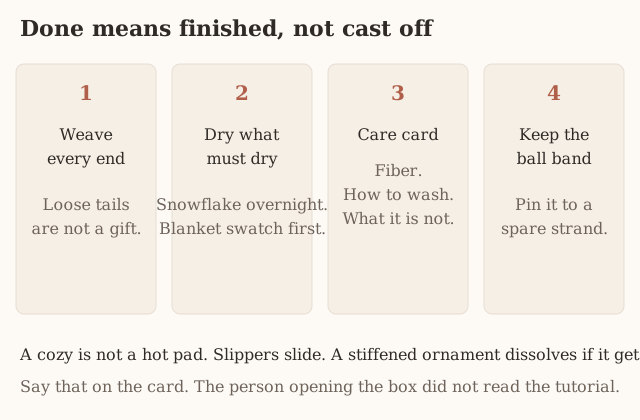
Weave before you call it done
- Do not tell someone a project is done when the ends are still hanging out.
- Weaving is part of the gift.
- On a small piece, weave before you sew the last appliqué so you are not trapping a tail under the flower.
- On a scarf or blanket, weave as you go every few rows if the tails will otherwise become a pile on December 22.
Give stiffener its day
- A snowflake or a star that is still damp is not ready to box.
- A blanket swatch that is still wet is not a reason to buy ten skeins.
- Dry flat.
- Do not hang a wet stiffened ornament. It will stretch into a new shape and then dry that way.
Write the care card
- Write a care card with three facts and put it in the box.
- The fiber, copied from the yarn label: acrylic, cotton, wool, or a blend. If you used more than one, name each.
- How to wash it. Copy the label’s symbols or write them out.
- Hand wash and dry flat is the safe default for anything with stuffing or stiffener.
- If the label is stricter, follow the label.
- What it is not. A cotton cozy is not a hot pad and it is not microwave-safe.
- Slippers slide on hard floors.
- A stiffened ornament dissolves or softens if it gets wet.
- A market bag is not load-rated.
- A coaster is not a trivet.
- Say so on the card, because the person opening it did not read the tutorial.
Keep the ball band yourself, pinned to a leftover length of yarn, so you can repair the gift later in the same yarn. If you used a metallic accent, keep a piece of that too. A repair in a different white is visible on a snowflake.
One last check against the number you wrote
- Check the object once more against the measurement you wrote down.
- Hat on the measured number, or against the hat you measured.
- Phone in its case, into the sleeve.
- Bottle into the bag, lifted by the handle.
- Card into the holder.
- Mug into the cozy, loop through the handle.
- If the check fails, you still have a tutorial to return to.
- Wrapping a failure does not turn it into a fit.
What not to promise, and what not to stack
Limits you do not get to invent
- Do not promise a date you have not scheduled.
- Do not promise that a guessed size will fit.
- Do not promise heat safety, floor grip, or a weight limit the linked page does not claim.
- Do not promise that a piece was made from a finished sample if you planned it from the tutorial’s gauge.
- Give the object, the care card, and an honest limit.
One project, not three
- Do not stack a new stuffed pattern into the same week as a blanket.
- The Santa page and the gnome page are two figures.
- The blanket is a third project.
- Pick one figure or the blanket.
- Do not turn this page into the pattern.
- If you want to change a stitch, you are no longer following the linked tutorial, and this page does not contain a replacement pattern for you to follow instead.
- Choose a different linked tutorial whose size and skill match the time you have.
Read the linked page once before you buy anything
Sit down with the tutorial and a blank card. You are not starting the project. You are finding out whether it is the project.
Copy the shape
- Copy the shape in one line, using the tutorial’s words.
- A mug cozy is a sideways strip with a loop through the handle.
- A beanie is a ribbed brim with a body picked up so it does not flare.
- A gnome is four pieces, hat long enough to read as a gnome.
- If you cannot write that line, you have not read the page, and the picture on this list is not a substitute.
Copy the measurements as blanks
- Copy every measurement the tutorial asks for, in the order it asks.
- Leave a blank beside each one.
- Fill a blank only from an object, not from a memory of an object.
- A blank you cannot fill is a reason to pick a different line on this page, not a reason to type a guess.
Copy the notions
- Copy the notions that are not yarn: elastic, button, zipper, stiffener, stuffing, a cord, a snap.
- Buy those with the first skein, not on the last evening.
- A snowflake without stiffener is a soft motif.
- A pumpkin zipper pouch without a zipper is a round opening.
- A scrunchie without the elastic is a strip.
Copy the limit
- Copy the sentence where the tutorial says what the object is not, if it has one.
- Bowl cozy: not a hot pad, not microwave-safe.
- Slippers: the sole slides.
- Market bag: not load-rated.
- Coasters: not a hot pad.
- Put that sentence on your care card now, while you remember which tutorial you opened.
- Then close the laptop and look at your calendar.
- If the notions, the blanks, and the drying day do not fit, choose again.
- Re-reading the same page will not create a measurement you do not have.
When the plan slips, switch on purpose
A slipped plan is a project that still has rows left on the day you needed it finished. Switching is allowed. Panicking into a new, unmeasured project is not.
A beanie that is only a brim
- If a weekend beanie is only a brim on Sunday afternoon, do not invent a hat from the rest of the skein.
- Weave the brim ends, set it aside for a later week, and make a gift card holder or a scrunchie for this deadline if you still want to give crochet.
- An unfinished brim in a box is not a hat.
A swatch that has not been washed
- If a blanket swatch has not been washed, do not buy the rest of the yarn so you feel started.
- Wash the swatch.
- If the dry swatch says the blanket will miss the date, the blanket waits.
- A smaller gift from this list can go in the box.
- You can still make the blanket in January from a swatch you trust.
A sleeve that will not take the device
- If a sleeve will not take the device, do not add random rounds and hope.
- Go back to the device case measurements, including thickness.
- If you measured the bare phone and they use a case, remeasure in the case.
- If you cannot get the device back, switch gifts.
- A sleeve that almost fits is a sleeve they will not use.
A snowflake that is still wet
- If a snowflake is still wet on the morning of the party, do not put it in tissue and call it dry.
- Give a different finished object, or give the snowflake the next day.
- A damp stiffened piece takes the shape of whatever presses it.
Write the switch down so you do not restart the failed project at midnight. One line: what stopped, which tutorial you opened instead, and what measurement that new tutorial needs. Then do only that.
| What stopped | Do this | Do not do this |
|---|---|---|
| Beanie is only a brim on Sunday | Weave the brim, box a gift card holder or a scrunchie | Invent a hat from the rest of the skein |
| Blanket swatch is unwashed | Wash it. If the date is gone, the blanket waits | Buy the rest of the yarn to feel started |
| Sleeve will not take the device | Remeasure in the case, including thickness, or switch | Add random rounds |
| Snowflake still wet | Give something else, or give it the next day | Tissue it and call it dry |
Which finishing method belongs to which gift
These are different operations. Using the wrong one wastes the day you saved for finishing.
Weaving ends
- Weaving ends belongs to all of them.
- The weaving page is the method.
- Do it before the gift is wrapped, including on a flower you will sew to a mug cozy.
- A tail sewn under a flower still comes out the side.
Washing a swatch
- Washing a swatch belongs to the baby blanket, before you buy the large amount of yarn.
- It can also belong to any project whose yarn label says it will change in water and whose size matters.
- Dry the swatch flat.
- Measure after it is dry.
- A wet measurement is larger or smaller than the gift will be, and you will not know which until it dries.
Stiffener and blocking flat
- Stiffener and blocking flat belong to the snowflake and to a star you chose to stiffen.
- Schedule a day.
- Pin or block as that tutorial says so the points dry in place.
- Do not hang the piece while it is wet.
Ordinary blocking
- Ordinary blocking is optional and sometimes useless.
- The weaving page says when it does nothing.
- Do not block a beanie to change its circumference.
- Do not block slippers to add grip.
- Do not block a bowl cozy to make it heat-safe.
- Blocking rearranges relaxed fabric.
- It does not add a property the yarn does not have.
A handled lift
- A handled lift belongs to the wine bottle bag.
- The finish test is the bottle in the bag and your hand on the handle, not on the cord.
A stretch check
- A stretch check belongs to the phone crossbody strap.
- Hang it, then measure again, before you wrap.
- The strap page is about fitting after stretch.
- A strap measured only on the sewing night is not the length they will wear.
A heat sentence
- A heat sentence belongs to the bowl cozy and the coasters.
- The finish is the sentence on the card, not a test in a microwave.
- Do not run that test.
- The pages do not claim the objects are safe for it.
The morning you wrap
What stays home, what goes in the box
- Lay the gift, the care card, and the measurement note on the table.
- The measurement note stays home.
- The care card goes in the box.
- The ball band stays home, pinned to spare yarn.
The one check that belongs to that object
- Card in and out of the holder.
- Mug through the cozy loop.
- Snowflake dry and flat, hanger firm.
- Scrunchie stretched and released.
- Beanie measured against the doubled brim number.
- Gloves as a pair, thumb gaps opposite the joins.
- Device in its case, into the sleeve.
- Bottle lifted by the handle.
- Gnome closed, with no loose pieces a child could pull off.
- Tree standing, or flat tree lying flat.
- Scarf ends woven.
- Hood large enough that you did not ignore the 12-inch warning.
- Blanket free of buttons and appliqués.
- Slippers paired, slip warning written.
- Zipper opened and closed.
- Market-bag handles woven, no weight promise.
- Bowl cozy on the right bowl, heat warning written.
If the check fails, you do not wrap it. You either fix it from the linked tutorial or you switch, using the rule above. A bow is not a fix.
Where the card sits in the box
- Pack the care card where it will be seen, not under a layer of tissue they will throw away.
- Fiber, wash method, and the limit.
- If two yarns were used, name both.
- If you sewed a flower to a cozy, say the flower is sewn on and should not be tugged off to use the yarn.
Pairs that stay one gift, and piles that become three
Combinations that stay one gift
- Some tutorials on this page can be combined without becoming a new pattern.
- The flower sewn to the mug cozy is one gift if the button and the handle loop stay clear.
- The leaf sewn to a plain wrapped present is one gift.
- A star and a snowflake are two ornaments, which is fine if both are dry.
- They are not a reason to skip drying on either.
Combinations that break a rule
- A leaf, a flower, or a button on the baby blanket breaks the no-buttons, no-appliqués rule.
- A gnome and a Santa in one week, plus or minus a blanket, is too many projects.
- A bowl cozy packaged as a hot pad breaks the heat rule.
- A market bag packaged with a promise about grocery weight breaks the load rule.
- Slippers packaged without the floor warning break the finishing note.
A pair is one project twice
- A pair of fingerless gloves is one project done twice, with the thumb gap opposite the join both times.
- It is not two patterns.
- A beanie and an ear warmer for the same person are two fittings.
- Make one unless your timing says both will be woven and checked.
- If you want the box to look fuller, add the care card, the spare-yarn note you kept at home, and a finished small piece you already checked.
- Do not add a half-done second tutorial.
Buy yarn after you know the tutorial, not before
The shop is where Christmas crochet goes wrong, because the skein is prettier than the calendar.
Walk in with four lines
- Walk in with the four lines from the linked page: shape, measurements, notions, and the limit.
- Match the fiber to the job using yarn for Christmas crochet.
- Stuffed gnome or tree: worsted acrylic is the page’s suggestion.
- Snowflake or anything that must hold a blocked shape: cotton or crochet thread.
- Metallic: a short accent, not the whole beanie.
- Candlelight: do not put the finished piece next to a flame, no matter which fiber you bought.
Read the label before the band goes in the bag
- Read the label in the shop.
- Copy the wash symbols onto your phone or a card before you throw the band into the bottom of a bag.
- You will need those symbols for the care card, and you will need the band at home for repairs.
- If the dye lot matters because you are making the blanket, buy the lot together after the swatch, not one skein now and more later.
- Later is a different dye lot.
How much to buy
- For a one-evening project, one skein of the weight that tutorial uses is the usual purchase, plus the notion.
- Do not buy a blanket quantity because the evening project might become a blanket.
- It will not, not by this date, if you have not swatched.
- Take the measurement card to the shop if the project is fitted.
- You do not need to ask the clerk to guess a hat size.
- You need your doubled brim measurement, or your decision to switch to an ear warmer because you do not have it.
A single gift, followed all the way to the box
Pick one line and stay with it. Here is what staying looks like for three different windows, without adding stitches this page does not own.
Evening path, gift card holder
- Confirm the card is ID-1, 3.370 by 2.125 inches.
- Open how to crochet a Christmas gift card holder.
- Copy its fold note: off center, so the card stays easy to pull out.
- Work that page.
- Sew as that page says.
- Weave ends.
- Slide the card in and out.
- Write the fiber and the wash method.
- Wrap it.
- There is no second project hiding in the same skein unless you have already finished this one and the evening is actually still young.
- If it is not, stop.
Weekend path, chunky beanie
- Two days before, lay their hat flat, measure the brim, double it, and write the number.
- Open how to crochet a chunky beanie.
- Swatch in the bulky yarn.
- Start the sideways ribbed brim only if the swatch is honest.
- Pick up the body the way that page shows so the hat does not flare.
- Weave ends on the last evening, not in the parking lot.
- Compare the hat with the number you wrote.
- If it flares, fix the pick-up from that page.
- Do not gift a flared brim because the yarn was expensive.
October path, baby blanket
- In October, swatch in half double crochet as the blanket tutorial describes.
- Wash the swatch, and dry it flat.
- Measure the dry swatch.
- Buy the yarn from that result, same dye lot.
- Work the plain rectangle.
- No buttons, no ties, no leaf, no flower.
- Weave ends as you go so December is not a tail-weaving month.
- Care card from the label.
- The blanket is finished when the size matches the washed gauge and the surface is plain.
Any other project on this page can be followed the same way: one tutorial, one measurement list, one finish test, one care card. The list at the top is a menu. The gift is the single page you completed.
Frequently asked
Which of these is the best first Christmas project?
The gift card holder or the flat star on the ornament page. Both are small, and both tell you quickly whether your tension will cooperate.
Can I sell these?
The tutorials explain techniques and original project notes for this site. Selling a finished object you made is ordinary. Copying another designer’s published pattern is not, and this page does not grant that.
How do I know an evening project will actually fit in an evening?
- Time ten rows, or one repeat, in your yarn.
- Multiply by the amount of crochet on the linked page, then add sewing and end-weaving.
- If stiffener is involved, add a drying day that is not part of the evening.
- The gift card holder can end when the sewing ends. The snowflake cannot.
I only have evenings, and the beanie is a weekend project. Can I still make it?
- Split the weekend method across evenings, and keep the measurement.
- Evening one is the swatch and the brim.
- Later evenings are the body.
- Do not start on the night before you need it.
- Bulky yarn is faster than worsted, and it is still not instant.
What if I cannot measure the person at all?
- Use the scrunchie, the flat star or another ornament on the ornament page, the gift card holder, or the ear warmer.
- Skip slippers, because the instep measurement only the foot can give.
- Skip a phone sleeve if you would be guessing the phone.
The snowflake is crocheted and still curly. Is it done?
- No. The tutorial stiffens and blocks it so it hangs flat.
- Give it the drying time.
- A damp snowflake boxed overnight will dry in the shape of the box.
Can I give the bowl cozy as a hot pad?
- No. It is cotton planned from a bowl.
- It is not a hot pad, and it is not claimed as microwave-safe.
- Do not microwave it.
- Write that on the care card.
Can I start the hooded scarf in December?
- Only if your ten-row timing says the remaining days are enough.
- Only if you have already read that a 12-inch panel will not fit an adult head.
- The hood is a long rectangle folded into a hood.
- Starting late is how it becomes a scarf with no hood.
Can I make the gnome and the Santa in one week?
- No. Santa is a separate technique page for that shape.
- The gnome is four pieces.
- A blanket in the same week is a third project.
- Pick one.
What goes on the care card?
The fiber from the label, how to wash it, and what the object is not. Keep the ball band at home, pinned to a spare strand, for a later repair.
The mug cozy will not close. What do I check?
- The mug, not a stand-in glass.
- The strip is worked sideways and the loop has to pass inside the handle.
- Measure that mug and follow the cozy tutorial again.
- Do not move the button so far that the fabric strains.
Can I sew the flower onto the beanie?
- Sew it only where the fabric does not have to stretch across the flower.
- A brim that stretches will buckle a stiff flower.
- The mug cozy, after the button is placed, is the combination this page already allows.
- Keep the flower off the button and off the handle loop.
Is the market bag a grocery tote I can promise will hold a full shop?
- No. The tutorial is not load-rated.
- Give it to someone who already carries a market bag, and say so on the card.
- Weave the ends at the handles.
Which gift needs no body measurement and no drying time?
- The gift card holder, if you have an ID-1 card and you weave the ends in the same sitting.
- The scrunchie needs an elastic, not a body measurement, and it does not need stiffener.
- The snowflake needs drying.
- The beanie needs a head or a hat to measure.
- christmas
- gifts
- beginner
Read this next
- How to Crochet a Christmas Tree Garlic Holder A small mesh garlic holder with scalloped branches, a gold star, and an open top. US terms. Sizes are design targets.
- How to Crochet a Christmas Tree Plastic Bag Holder Crochet a hollow Christmas tree that holds grocery bags. Bags go in the open top and out the brown trunk. US terms. Sizes come from gauge.
- How to Crochet a Compact No-Slip Kitchen Towel Holder A compact cotton crochet towel holder with two wooden rings, one above the other. Assembly counts are still being checked. US terms.