

Ideas de regalos navideños a ganchillo
Regalos que puedes tejer con tutoriales ya en este sitio, ordenados por tiempo y para quién son.
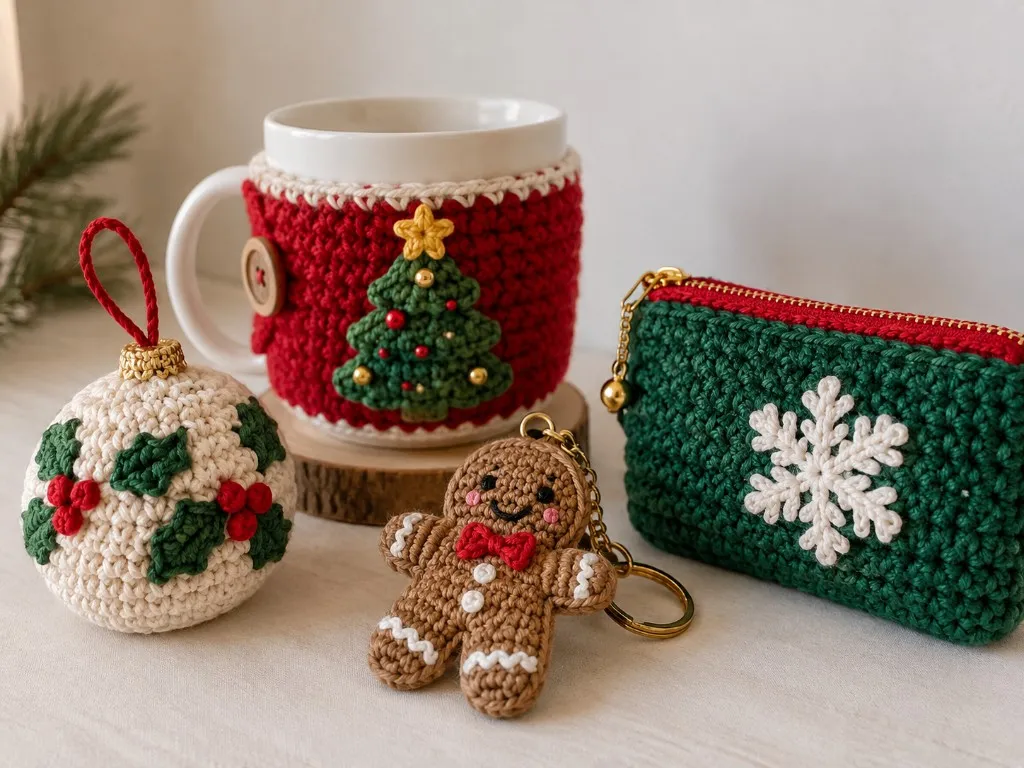
En esta página
- Si tienes una tarde
- Si tienes un fin de semana
- Si empiezas en octubre
- Personas que no quieren otro gorro
- Medir un regalo sin preguntar
- Pon una tarjeta de cuidado en la caja
- Qué no prometer
- Elige un tutorial que puedas medir y terminar
- Usa esta página para elegir, luego sal de ella
- Pon el regalo en el calendario
- Una tarde: elige, mide y termina cada regalo pequeño
- Fin de semana: mide primero, luego la pieza gruesa o ajustada
- Desde octubre: piezas largas y con partes
- Personas que no quieren otro gorro (más opciones)
- Medir sin preguntar (repaso)
- Terminar para poder envolver
- Qué no prometer y qué no apilar
- Lee la página enlazada una vez antes de comprar
- Cuando el plan se retrasa, cambia a propósito
- Qué método de acabado corresponde a qué regalo
- La mañana en que envuelves
- Parejas que siguen siendo un regalo, y pilas que son tres
- Compra hilo después de conocer el tutorial, no antes
- Un solo regalo, de punta a punta hasta la caja
- Preguntas frecuentes
La pregunta útil de Navidad no es qué inventar en diciembre. Es qué objeto terminado puedes completar de verdad antes de la fecha del calendario.
Cada proyecto abajo ya tiene tutorial en este sitio. El hilo que se comporta bien en puntadas pequeñas navideñas está en lana para ganchillo navideño.
Esta guía apunta a tutoriales existentes, no a un patrón nuevo. Elige el proyecto que puedas terminar, no el de fecha más reciente.
Si tienes una tarde
- Portatarjetas navideño. Bolsillo plano. Uno de los pocos regalos terminados cuando acaba la costura.
- Cozy para taza. Mide la taza primero o no cerrará.
- Copo de nieve. Tres vueltas y endurecido. Deja un día para secar duro.
- Scrunchie. Se mide desde una goma del pelo; no necesitas medidas corporales.
- Flor simple. Cósela a un regalo liso o al cozy de taza.
- Hoja otoñal. Apliqué pequeño. El conteo está en papel, no de una hoja terminada.
- Posavasos de Halloween. Disco plano de calabaza y set granny. No es salvamanteles.
La página de adornos es un menú
- Ideas de adornos lista quince formas y escribe una estrella plana completa.
- Usa esa estrella si quieres patrón escrito.
- Usa los enlaces de esa página para árbol y copo.
- Quince ideas son menú. Una estrella terminada es regalo.
Si tienes un fin de semana
- Gorro grueso. Hilo bulky termina antes que worsted. Mide la cabeza.
- Orejeras. Buen regalo si no conoces la talla de gorro.
- Guantes sin dedos. Mide la mano primero. Con la abertura del pulgar opuesta a la unión del espiral, ambos guantes se trabajan igual.
- Funda libro o e-reader. Mide el aparato. La misma forma plegada encaja en muchos e-readers si mides en lugar de adivinar marca.
- Bolsa para botella de vino. La botella es el molde. Teje a esa botella.
Si empiezas en octubre
- Gnomo. Cuatro piezas pequeñas. La longitud del gorro lo hace leerse como gnomo.
- Árbol de Navidad. Cono, no manta.
- Bufanda principiante. Un punto repetido. Muestra antes de confiar en el ancho.
- Bufanda con capucha. Larga. Empiézala antes de diciembre.
- Manta de bebé. Rectángulo liso. Lava muestra antes de comprar todo el hilo. Sin botones ni apliqués.
- Pantuflas. Suela solo de hilo resbala en suelo de madera. Lee las notas finales antes de regalar.
Personas que no quieren otro gorro
- Bolsa con cordón si aún hay hilo de Halloween, o neceser y monedero calabaza con cremallera.
- Funda portátil o funda móvil solo si puedes medir el aparato. Un móvil adivinado no encaja. Móvil con correa: bandolera móvil.
- Bolsa de mercado para quien realmente use una.
- Cozy para cuenco solo tras leer la sección de calor. Es algodón, no salvamanteles, y no dice ser apto microondas.
Medir un regalo sin preguntar
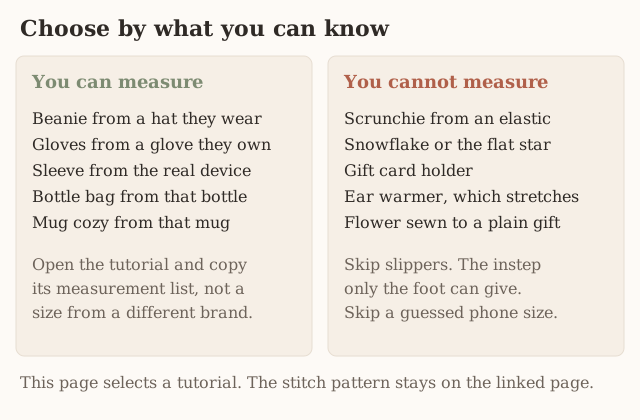
La mitad de los proyectos arriba necesitan medida, y preguntar estropea la sorpresa. Mide algo que la persona ya tenga.
Un gorro que use
- Extiéndelo plano.
- Mide el ala y duplica.
- Esa es la talla relajada del gorro, con la holgura que ya le gusta.
- Úsala como objetivo en el gorro grueso.
Un móvil o e-reader
- Mide el aparato en la funda que use, porque eso es lo que debe entrar.
- La funda móvil explica por qué el grosor importa tanto como el ancho.
Guantes
- Mide el contorno de la palma de un guante que le quede, plano, y duplica.
- Lleva ese número al tutorial de guantes. No adivines una mano que no has visto.
Pantuflas o zapatos
- Mide la longitud interior de un zapato que use, talón a punta.
- Se acerca a la longitud del pie; un zapato suele tener holgura extra.
- Las pantuflas también necesitan medida sobre el empeine, que solo da el pie; son difíciles como sorpresa.
Si no puedes medir nada, elige un proyecto que no lo pida: scrunchie, adorno, portatarjetas u orejeras, que tienen elasticidad.
Pon una tarjeta de cuidado en la caja
Un regalo a ganchillo se arruina fácil en el primer lavado. Escribe una tarjeta con tres datos y métela dentro.
Los tres datos
- La fibra, copiada de la etiqueta: acrílico, algodón, lana o mezcla.
- Cómo lavarlo. Copia símbolos de la etiqueta o escríbelos. Lavado a mano y secado plano es lo seguro por defecto con relleno o endurecedor.
- Qué no es. Un cozy de algodón no es salvamanteles. Las pantuflas resbalan en suelo duro. Un adorno endurecido se disuelve si se moja. Dilo en la tarjeta; quien lo abre no leyó el tutorial.
Quédate la banda de la madeja, sujeta a un resto de hilo, para reparar después con el mismo hilo.
Qué no prometer
- No digas que está hecho si los extremos siguen colgando.
- Rematar extremos es parte del regalo.
- No metas un amigurumi nuevo la misma semana que una manta.
- El tutorial de Santa es página de técnica para esa forma, aparte del gnomo.
Elige un tutorial que puedas medir y terminar
Lee la página enlazada antes de comprar
- Abre el patrón enlazado antes de comprar hilo.
- Anota habilidades, medidas, accesorios y tiempo de secado.
- Para gorro, orejeras o guantes, consigue medida u objeto de referencia.
- La elasticidad no elimina la necesidad de medir el regalo.
- Cronometra una repetición o diez filas con tu hilo.
- Estima el ganchillo restante y suma montaje, remates y secado o bloqueo.
- Un adorno que debe secar toda la noche no está listo al último punto.
- Esta página es selector de proyectos. Las instrucciones completas están en las páginas enlazadas.
Usa esta página para elegir, luego sal de ella
Los conteos viven en la página enlazada
- Cada proyecto nombrado ya tiene su tutorial.
- Esta página no añade patrón de puntos nuevo, gnomo nuevo ni bufanda nueva.
- Si una frase suena a conteo que debes copiar al cuaderno como patrón, para y abre el enlace.
- Los conteos están allí.
- Aquí vive la decisión: qué tutorial puedes terminar, qué medir antes de comprar hilo, cómo ponerlo en el calendario y qué significa terminado tras el último punto.
Cuatro líneas, luego tu propio ritmo
- Abre la página enlazada antes de comprar hilo.
- Escribe cuatro líneas: habilidades que asume, medidas que pide, notions que no son hilo, y tiempo de secado o lavado.
- Un copo que necesita un día para endurecer no es regalo de una tarde el 24 si empiezas esa noche.
- Una manta de bebé que pide lavar muestra no es proyecto de un día: la muestra debe secar antes de confiar en la talla y comprar el resto del hilo.
- Cronometra tus manos. Diez filas o una repetición con el hilo que usarás. Anota minutos.
- Multiplica por las unidades que indica la página enlazada y suma montaje, remates y secado.
- Ese producto es estimación según tu velocidad, no promesa impresa aquí.
- Si la estimación no cabe en tus días, elige un tutorial más pequeño.
- No te quedes con el grande y saltes rematar extremos.
El hilo que se comporta en puntadas pequeñas navideñas está en lana para ganchillo navideño. Versión corta para elegir proyecto antes que fibra: acrílico worsted para piezas rellenas, algodón o hilo de crochet cuando debe mantener forma bloqueada, hilo metálico solo como acento corto, y ningún ganchillo junto a vela encendida. Un hilo metálico festivo en tienda oculta puntadas y es mala elección para el primer proyecto de diciembre.
Pon el regalo en el calendario
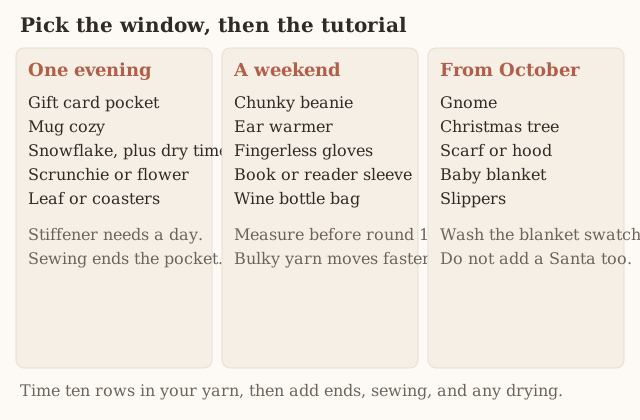
Cuenta atrás desde la entrega
- Escribe la fecha en que entregarás el regalo.
- Cuenta hacia atrás.
- Reserva un día en el calendario para secado si el tutorial usa endurecedor o pide lavar muestra.
- Reserva bloque para rematar extremos si la pieza es larga.
- Una bufanda con cola en cada fila no está terminada al último punto.
- Rematar extremos es parte del regalo.
- Usa tres ventanas y no subas un proyecto a una ventana más pequeña porque te guste.
Una tarde
- Una tarde significa que ganchillo y costura caben en una sentada.
- Revisa la mañana siguiente solo si algo debe secar.
- El portatarjetas entra aquí porque termina al coser.
- El copo entra para el ganchillo y sale para el endurecedor.
- Empieza el copo una tarde con el día siguiente libre.
Un fin de semana
- Fin de semana: medir, muestra y terminar pieza bulky o pequeña ajustada, extremos rematados antes del lunes.
- Gorro grueso encaja mejor que bufanda worsted porque bulky termina antes.
- Sigue necesitando medida de cabeza antes del primer punto.
- No empieces domingo por la noche.
Desde octubre
- Desde octubre: pieza larga, varias partes, muestra lavada, o fácil de subestimar.
- Bufanda con capucha, manta bebé, gnomo, árbol y pantuflas van aquí.
- Empezarlas la segunda semana de diciembre es cómo quedan regalos sin terminar con lazo en el WIP.
No metas el tutorial de Santa la misma semana que una manta. Santa es página de técnica aparte del gnomo. Dos piezas rellenas más un rectángulo grande son tres proyectos. Elige uno.
| Ventana | Qué puede terminarse | Qué aún necesita otro día |
|---|---|---|
| Una tarde | Portatarjetas, al coser | Endurecedor del copo. Ganchillo esa tarde; secado al día siguiente |
| Fin de semana | Gorro, orejeras, guantes, funda, bolsa botella, extremos antes del lunes | Medida de cabeza u objeto antes del primer punto. No empezar domingo noche |
| Desde octubre | Gnomo, árbol, bufanda, capucha, manta, pantuflas | Muestra lavada, varias partes o rectángulo largo. Empezar en diciembre = sin terminar |
Una tarde: elige, mide y termina cada regalo pequeño
Portatarjetas
- Elígelo cuando cuesta medir a la persona y aun quieres que el regalo sea ganchillo, no solo tarjeta en sobre.
- El tutorial enlazado es bolsillo plano para una tarjeta ID-1, 3,370 × 2,125 pulgadas, plegado descentrado para sacar la tarjeta con facilidad.
- No necesitas talla de mano.
- Necesitas tarjeta regalo de ese tamaño estándar, igual que tarjeta bancaria.
- Mide la tarjeta que meterás si dudas que sea ID-1.
- Trabaja el bolsillo según ese tutorial, cose como describe y remata extremos.
- Terminado cuando la tarjeta entra y sale sin enganchar colas.
- Sin endurecedor ni espera de noche.
Cozy de taza
- Elígelo si puedes pedir la taza o una idéntica.
- El tutorial es tira trabajada de lado, con lazo que pasa dentro del asa y un botón.
- Si adivinas la taza de memoria, la tira no se encontrará.
- Mide altura a cubrir y contorno.
- Ten en cuenta el asa como indica esa página: el lazo debe pasar dentro, no encima.
- Termina cosiendo el botón donde la tira cerrada cae en esa taza, no donde cayó en un vaso sustituto.
- Una flor del tutorial de flor puede coserse después del botón, sin tapar ojal ni lazo.
Copo de nieve
- Elígelo para adorno de árbol si puedes darle un día de secado.
- Nota de esta página: tres vueltas y endurecido.
- El tutorial construye copo de seis puntas desde anillo central, endurece y bloquea para colgar plano.
- Programa ganchillo una tarde y secado como paso siguiente en el calendario.
- No está terminado al último punto.
- Terminado cuando está seco, plano y con colgante que no se salga.
- Mantén lejos de vela encendida, como dice la página de hilo para cualquier ganchillo.
- Pieza endurecida se ablanda si se moja. Dilo en la tarjeta de cuidado.
Scrunchie
- Elígelo si no conoces talla de ropa.
- El tutorial mide la tira desde goma del pelo, unos dos veces su longitud, cose la tira alrededor y fruncir.
- Compra o pide la goma primero.
- No tejas tira y esperes que una goma del cajón encaje.
- Termina comprobando que la goma sigue elástica tras la costura y que la costura no hace bulto en la cabeza.
- Remata extremos en el tejido fruncido para que no pinchan.
Flor simple
- Elígela como extra, no como único regalo, salvo cosida a un paquete que la persona ya quiera.
- Tutorial: flor plana de cinco pétalos.
- Incluye hoja en un paso bajando por cadena.
- Cósela al cozy o a regalo liso.
- No la cosas sobre botón, lazo o cordón.
- Terminado = hilo de costura firme y flor plana.
- Flor con centro suelto se cae en la bolsa.
Hoja otoñal
- Elígela para apliqué pequeño si leíste que el conteo está en papel, no de hoja terminada.
- Tutorial trabaja la hoja a ambos lados de cadena y la forma por altura de punto, dos tallas.
- Elige talla antes de cadena y sigue conteos de esa talla en esa página.
- No promedios.
- Termina cosiéndola a algo que aguante puntadas: bolsa regalo lisa, esquina de bufanda ya hecha, o tarjeta.
- No la cosas a ala elástica de gorro sin comprobar si se frunce al estirar.
Posavasos Halloween
- Están en la lista porque disco calabaza plano y set granny son rápidos, y en diciembre aún hay quien quiere algo para mesa.
- No son salvamanteles.
- Elígelos si un posavasos es útil de verdad, y di en la tarjeta que no son para sartén caliente.
- El tutorial mantiene el disco plano con su plan de aumentos.
- Si el disco se abomba o ondula, sigue arreglo de esa página.
- No añadas vueltas hasta que parezca grande y regales círculo deforme.
- Termina rematando y dejando el set plano.
- Posavasos que se enrolla no sostiene vaso.
Página de adornos
- Ideas de adornos lista quince formas y escribe una estrella plana completa.
- Usa esa estrella si quieres patrón escrito esta noche.
- Usa enlaces de esa página para árbol o copo, no los inventes aquí.
- Elige estrella para un regalo colgante con conteos ya escritos.
- No midas cuerpo.
- Planifica colgante y, si endureces, día de secado.
- Quince ideas son menú. Una estrella terminada es regalo.
- No empieces tres formas el 23 de diciembre.
| Regalo de una tarde | Qué necesitas antes | Terminado significa |
|---|---|---|
| Portatarjetas | Tarjeta ID-1, 3,370 × 2,125 in | Tarjeta entra y sale, extremos rematados. Sin noche de espera |
| Cozy taza | Taza real, asa incluida | Botón cae en esa taza. Lazo pasa dentro del asa |
| Copo | Día libre tras tres vueltas | Seco, plano, colgante firme |
| Scrunchie | Goma del pelo antes de cadena | Goma sigue elástica. Costura sin bulto |
| Flor u hoja | Algo donde coserla | Hilo firme, lejos de botones, lazos y cordones |
| Posavasos | Uso en mesa y límite en tarjeta | Set plano. No salvamanteles |
Fin de semana: mide primero, luego la pieza gruesa o ajustada
Gorro grueso
- Elígelo si puedes medir cabeza o gorro que ya use, y usar hilo bulky para que el fin de semana alcance.
- El tutorial usa ala acanalada de lado y muestra cómo recoger el cuerpo uniforme para que no abra.
- Extiende su gorro, mide el ala y duplica.
- Esa es talla relajada, con la holgura que ya le gusta.
- Lleva ese número a la página del gorro como objetivo.
- No empieces el ala con cadena al azar y pruebes si es la persona a la que sorprendes.
- Termina rematando extremos del ala y comprobando que la recogida no abrió.
- Primer centímetro abierto no se bloquea en gorro ajustado.
- Bloquear no redimensiona.
Orejeras
- Elígelas si no conoces talla de gorro y aun quieres algo para la cabeza.
- Tutorial: banda acanalada.
- La cadena es ancho y las filas contorno.
- Aún se mide desde cabeza, pero la elasticidad del canalé perdona más que gorro ajustado.
- Si no puedes medir nada, esta es la opción de cabeza que permite esta página, no el gorro.
- Termina cuando la banda se une sin torcer y entra sin hueco atrás.
- Unión torcida es fila nueva, no tirón.
Guantes sin dedos
- Elígelos si puedes medir mano o guante que le quede, y hacer dos igual.
- El tutorial mide desde muñeca, nudillos y pulgar.
- Regla de esta página: medir primero; con hueco de pulgar opuesto a la unión del espiral, ambos guantes se trabajan igual.
- No reflejes el segundo guante en otro patrón.
- Extiende guante que le quede, mide palma y duplica.
- Abre tutorial de guantes y usa medidas de muñeca, nudillo y pulgar del guante prestado.
- Si el guante no da longitud de pulgar, no adivines.
- Cambia a orejeras o scrunchie.
- Termina rematando ambos guantes y comprobando hueco de pulgar opuesto a unión en cada uno.
- Hueco desplazado hacia la unión quedará mal en la mano.
Funda libro o e-reader
- Tutorial funda dispositivo: método por forma — funda plana plegada para portátil, libro o tablet, o bolsa redonda para algo pequeño.
- Para regalo de fin de semana, elige funda plana solo si puedes medir el aparato, idealmente en la funda que ya use.
- Ancho y grosor importan.
- Funda planificada desde tablet desnuda no entrará con funda gruesa.
- Anota medidas antes de cadena.
- Termina cuando el aparato entra con funda, el pliegue no abre a los lados y extremos rematados.
- Funda que solo encaja desnudo no es el regalo que mediste.
Bolsa botella de vino
- Elígela cuando tienes la botella.
- El tutorial usa esa botella como molde: base, lados y cordón planificados, con asa para no levantar por el cordón.
- No sustituyas botella parecida de tienda si la de regalo es otra forma.
- Termina metiendo botella real, cerrando cordón y levantando por el asa.
- Si solo puedes llevarla por el cordón, el asa no está terminada.
- Remata extremos para que no caigan al cuello de la botella.
Mide antes del primer punto en cada proyecto de fin de semana. Gorro sin ala duplicada, guantes sin palma, funda sin grosor y bolsa botella sin esa botella son suposiciones. Suposición = regalo que no encaja.
Desde octubre: piezas largas y con partes
Gnomo
- Elígelo si puedes empezar pronto y quieres figura rellena, no prenda.
- Tutorial: cuatro piezas — cuerpo de arriba abajo a base plana, gorro alto, nariz y barba.
- La longitud del gorro lo hace leerse como gnomo; en esa página el gorro baja hasta la nariz.
- La base se pesa antes de cerrar.
- Programa cuerpo, gorro, nariz y barba en sesiones separadas si tu tiempo de diez filas no cabe en una.
- Terminado = peso dentro, cierre hecho, gorro a la longitud de esa página, sin extremos sueltos que un niño tire.
- Sin botones ni ojos de plástico desprendibles.
- Sigue esa página para la cara.
- Esta página no es un segundo patrón de gnomo.
Árbol de Navidad
- Elige árbol para decoración si leíste que es cono, no manta.
- Tutorial: cono de pie desde punta, triángulo plano y vueltas apiladas.
- Elige una de las tres antes de cadena y sigue conteos de esa forma en esa página.
- Cono de pie necesita base plana y peso si esa página lo pide, o no se sostiene.
- Triángulo plano si quieres adorno, no pieza de mesa.
- No empieces cono y cambies a triángulo en mismo hilo sin leer segundo conteo.
- Termina el de pie solo cuando se sostiene solo.
- Termina el plano cuando yace plano y tiene colgante.
Bufanda principiante
- Elígela si la persona usará bufanda y tienes tiempo para muestra.
- Tutorial planifica bufanda en media punto alto desde tu muestra.
- Ancho = conteo de puntos. Largo = filas.
- Muestra antes de confiar en ancho.
- Muestra más ancha de lo pensado = bufanda más pesada y más hilo del comprado.
- Compra tras muestra, no antes.
- Termina rematando cada extremo.
- Bufanda larga con cola en cada cambio de color no está hecha.
- Bloquea solo si aplica la página de remates.
- Bloquear no ensancha muestra estrecha.
Bufanda con capucha
- Elígela solo si octubre aún es honesto.
- Tutorial explica capucha plegada desde rectángulo; panel de 12 pulgadas no cabe en cabeza adulta.
- Lee ese límite antes de cadena.
- Mide o sigue dimensiones adultas de esa página; no acortes panel para ahorrar hilo.
- Proyecto largo. Ponlo en calendario en semanas, no en tardes.
- Termina cuando pliegue de capucha coincide con esa página, extremos de bufanda parejos y rematados.
- Capucha corta por panel acortado no se convierte en capucha al lavar.
Manta de bebé
- Elígela si puedes lavar muestra y esperar secado antes de comprar resto del hilo.
- Tutorial: rectángulo liso en media punto alto desde muestra lavada.
- Sin botones ni apliqués.
- Manta con botones o lazos es riesgo; por eso esta página dice no.
- Termina cuando rectángulo tiene tamaño que predice jauge lavada, extremos rematados y tarjeta copia etiqueta.
- No cosas hoja, flor ni gnomo.
- Liso es el regalo.
Pantuflas
- Elígelas solo si puedes medir pie, incluido empeine, o aceptas que son difíciles como sorpresa.
- Tutorial: suela, puntera ancha sobre dedos y pared de talón.
- Suela solo de hilo resbala en madera.
- Lee notas finales antes de regalar; pon aviso de resbalón en tarjeta.
- Longitud interior de zapato ≈ pie, con holgura extra.
- No sustituye medida de empeine.
- Sin empeine, elige otro regalo.
- Termina con pareja igual y aviso escrito.
- No prometas seguridad en escaleras o suelo duro.
| Proyecto de octubre | Partes o límite en su página | No regalar cuando |
|---|---|---|
| Gnomo | Cuatro piezas. Gorro hasta nariz. Base pesada antes de cerrar | Extremos sueltos, botones u ojos que un niño quite |
| Árbol | Cono de pie, triángulo plano o vueltas apiladas. Elige uno | Cono no se sostiene, o plano sin colgante |
| Bufanda | Media punto alto desde muestra | Extremos colgando en cada cambio de color |
| Bufanda capucha | Panel 12 in no cabe en cabeza adulta | Panel acortado para ahorrar hilo |
| Manta bebé | Rectángulo liso desde muestra lavada | Botones, lazos, hoja, flor o gnomo cosidos |
| Pantuflas | Suela, puntera, talón. Empeine solo lo da el pie | Sin empeine o sin aviso de resbalón |
Personas que no quieren otro gorro (más opciones)
El gorro es el regalo a ganchillo por defecto, y mucha gente ya tiene uno. Elige de esta lista cuando la persona lo haya dicho, o cuando nunca la hayas visto con gorro.
Bolsa con cordón, neceser o monedero calabaza con cremallera
- La bolsa con cordón usa base redonda, con cordón por una vuelta de ojales.
- Úsala si aún hay hilo de Halloween y una bolsa pequeña encaja.
- El neceser se mide por lo más ancho, grueso y alto que esa persona lleve; necesitas esos objetos o preguntar.
- El monedero calabaza con cremallera lleva cremallera cosida a mano en abertura redonda y tallo.
- La cremallera es un accesorio que compras antes de la última vuelta, no después: abertura y cinta deben coincidir.
- Termina la bolsa de cordón probando el cordón.
- Termina la de cremallera abriéndola y cerrándola vacía y luego con lo que midió.
- Una cremallera en abertura redonda que frunce no mejorará al lavar.
Funda portátil, funda móvil o bandolera móvil
- Las tres necesitan medida.
- La funda de portátil o tablet es la forma plegada del tutorial funda dispositivo.
- La funda móvil explica por qué el grosor importa tanto como el ancho.
- Mide el móvil en la funda que use.
- No copies un ejemplo de marca de esa página a otro móvil.
- Un tamaño adivinado es un regalo que no encaja.
- Móvil con correa: bandolera móvil.
- Esa página mide la correa, la fija para que aguante y la ajusta tras el estiramiento.
- Una correa bien el día que cosiste puede alargarse.
- Comprueba la longitud después de colgarla, antes de envolver.
- Termina cuando el aparato entra y la correa, si hay, sigue aguantando con el aparato dentro.
Bolsa de mercado
- Elígela solo para quien ya lleve una.
- El tutorial es algodón, base sólida en punto bajo, lados de malla, banda firme y asas por conteo.
- No tiene carga nominal.
- No prometas que aguante cualquier peso de la compra.
- Termina rematando en los asas, donde una cola suelta es fea y débil, y escribe en la tarjeta que es algodón y no bolsa homologada.
- Si no sabes si usaría bolsa de mercado, haz un scrunchie.
Cozy para cuenco
- Elígelo solo tras leer la sección de calor de la página cozy para cuenco.
- Es cozy de algodón a dos capas planificado desde tu cuenco.
- No es salvamanteles.
- No dice ser apto microondas.
- No lo metas al microondas.
- Mide el cuenco con el que lo regalarás, o uno idéntico.
- Termina cuando encaja en ese cuenco, las capas están firmes y la tarjeta dice que no es salvamanteles ni para microondas.
- Regalarlo con nota alegre sobre recalentar sopa es peligroso.
- Escribe el límite.
Medir sin preguntar (repaso)
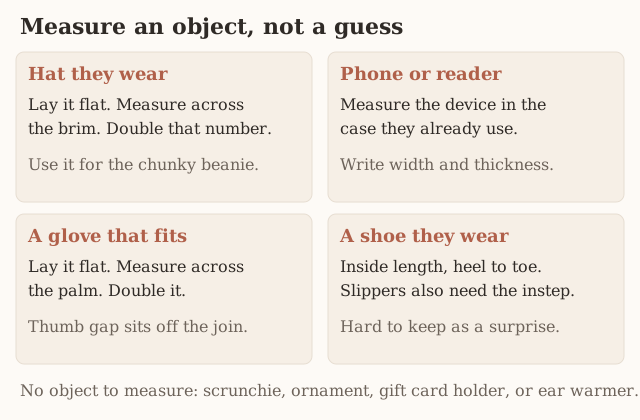
Half the projects need a number, and asking spoils the surprise. Measure an object they already use. Write the number on paper. Do not hold it in your head until you are at the hook.
A hat they wear
- Lay it flat, measure across the brim, and double it.
- That relaxed size already includes the ease they like.
- Use it as the target in the chunky beanie.
- Measure the brim, not the pom-pom and not the folded cuff unless the tutorial tells you the cuff is the measurement.
- A number taken across a slouchy crown is larger than the head.
A phone or e-reader
- Measure the device in the case they use, because that is what has to fit.
- Record width, height, and thickness.
- The phone case is where thickness is explained.
- A sleeve with the right width and too little depth will not close around a cased phone.
Gloves
- Measure across the palm of a glove that fits, lying flat, and double it.
- Use the glove tutorial for wrist, knuckle, and thumb if that owned glove can give them to you.
- If it cannot, leave the glove project.
Slippers or shoes
- Measure the inside length of a shoe they wear, heel to toe.
- That is close to foot length, though a shoe usually has a little extra room.
- Slippers also need a measurement over the top of the foot, which only the foot can give.
- If you only have the shoe length, you do not have enough.
- Choose a different gift.
A mug
- Measure the mug, including how the handle sits.
- The cozy’s loop has to pass inside it.
- A water glass is not that mug.
A bottle
- Measure the bottle you will put in the bag.
- A standard bottle from memory is not that bottle.
A bowl
- Measure the bowl the cozy is for.
- A larger bowl will not sit in a cozy planned for a smaller one.
- The cozy is still not a hot pad.
If you cannot measure anything, pick a project that does not need a body or a device: the scrunchie, an ornament or the flat star, the gift card holder, or the ear warmer, which has some stretch. The flower and the leaf are appliqués. They need something to be sewn to, not a body measurement.
| Object you can borrow | What to write down | Project it unlocks |
|---|---|---|
| A hat, laid flat | Brim width, doubled | Chunky beanie |
| A phone in its case | Width, height, and thickness | Phone case, sleeve, or crossbody |
| A glove, laid flat | Palm width, doubled, plus wrist, knuckle, and thumb if the glove shows them | Fingerless gloves |
| A shoe | Inside length, heel to toe. Instep still missing | Not enough for slippers |
| A mug | Height, around, and the handle opening | Mug cozy |
| The actual bottle | That bottle, not a similar one | Wine bottle bag |
| The actual bowl | That bowl | Bowl cozy, with the heat limit on the card |
Terminar para poder envolver
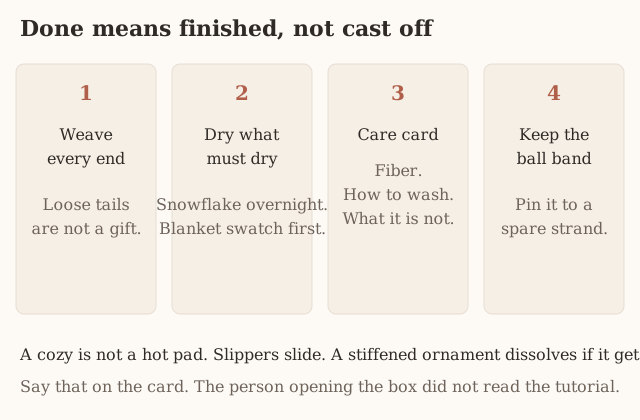
Weave before you call it done
- Do not tell someone a project is done when the ends are still hanging out.
- Weaving is part of the gift.
- On a small piece, weave before you sew the last appliqué so you are not trapping a tail under the flower.
- On a scarf or blanket, weave as you go every few rows if the tails will otherwise become a pile on December 22.
Give stiffener its day
- A snowflake or a star that is still damp is not ready to box.
- A blanket swatch that is still wet is not a reason to buy ten skeins.
- Dry flat.
- Do not hang a wet stiffened ornament. It will stretch into a new shape and then dry that way.
Write the care card
- Write a care card with three facts and put it in the box.
- The fiber, copied from the yarn label: acrylic, cotton, wool, or a blend. If you used more than one, name each.
- How to wash it. Copy the label’s symbols or write them out.
- Hand wash and dry flat is the safe default for anything with stuffing or stiffener.
- If the label is stricter, follow the label.
- What it is not. A cotton cozy is not a hot pad and it is not microwave-safe.
- Slippers slide on hard floors.
- A stiffened ornament dissolves or softens if it gets wet.
- A market bag is not load-rated.
- A coaster is not a trivet.
- Say so on the card, because the person opening it did not read the tutorial.
Keep the ball band yourself, pinned to a leftover length of yarn, so you can repair the gift later in the same yarn. If you used a metallic accent, keep a piece of that too. A repair in a different white is visible on a snowflake.
One last check against the number you wrote
- Check the object once more against the measurement you wrote down.
- Hat on the measured number, or against the hat you measured.
- Phone in its case, into the sleeve.
- Bottle into the bag, lifted by the handle.
- Card into the holder.
- Mug into the cozy, loop through the handle.
- If the check fails, you still have a tutorial to return to.
- Wrapping a failure does not turn it into a fit.
Qué no prometer y qué no apilar
Limits you do not get to invent
- Do not promise a date you have not scheduled.
- Do not promise that a guessed size will fit.
- Do not promise heat safety, floor grip, or a weight limit the linked page does not claim.
- Do not promise that a piece was made from a finished sample if you planned it from the tutorial’s gauge.
- Give the object, the care card, and an honest limit.
One project, not three
- Do not stack a new stuffed pattern into the same week as a blanket.
- The Santa page and the gnome page are two figures.
- The blanket is a third project.
- Pick one figure or the blanket.
- Do not turn this page into the pattern.
- If you want to change a stitch, you are no longer following the linked tutorial, and this page does not contain a replacement pattern for you to follow instead.
- Choose a different linked tutorial whose size and skill match the time you have.
Lee la página enlazada una vez antes de comprar
Sit down with the tutorial and a blank card. You are not starting the project. You are finding out whether it is the project.
Copy the shape
- Copy the shape in one line, using the tutorial’s words.
- A mug cozy is a sideways strip with a loop through the handle.
- A beanie is a ribbed brim with a body picked up so it does not flare.
- A gnome is four pieces, hat long enough to read as a gnome.
- If you cannot write that line, you have not read the page, and the picture on this list is not a substitute.
Copy the measurements as blanks
- Copy every measurement the tutorial asks for, in the order it asks.
- Leave a blank beside each one.
- Fill a blank only from an object, not from a memory of an object.
- A blank you cannot fill is a reason to pick a different line on this page, not a reason to type a guess.
Copy the notions
- Copy the notions that are not yarn: elastic, button, zipper, stiffener, stuffing, a cord, a snap.
- Buy those with the first skein, not on the last evening.
- A snowflake without stiffener is a soft motif.
- A pumpkin zipper pouch without a zipper is a round opening.
- A scrunchie without the elastic is a strip.
Copy the limit
- Copy the sentence where the tutorial says what the object is not, if it has one.
- Bowl cozy: not a hot pad, not microwave-safe.
- Slippers: the sole slides.
- Market bag: not load-rated.
- Coasters: not a hot pad.
- Put that sentence on your care card now, while you remember which tutorial you opened.
- Then close the laptop and look at your calendar.
- If the notions, the blanks, and the drying day do not fit, choose again.
- Re-reading the same page will not create a measurement you do not have.
Cuando el plan se retrasa, cambia a propósito
A slipped plan is a project that still has rows left on the day you needed it finished. Switching is allowed. Panicking into a new, unmeasured project is not.
A beanie that is only a brim
- If a weekend beanie is only a brim on Sunday afternoon, do not invent a hat from the rest of the skein.
- Weave the brim ends, set it aside for a later week, and make a gift card holder or a scrunchie for this deadline if you still want to give crochet.
- An unfinished brim in a box is not a hat.
A swatch that has not been washed
- If a blanket swatch has not been washed, do not buy the rest of the yarn so you feel started.
- Wash the swatch.
- If the dry swatch says the blanket will miss the date, the blanket waits.
- A smaller gift from this list can go in the box.
- You can still make the blanket in January from a swatch you trust.
A sleeve that will not take the device
- If a sleeve will not take the device, do not add random rounds and hope.
- Go back to the device case measurements, including thickness.
- If you measured the bare phone and they use a case, remeasure in the case.
- If you cannot get the device back, switch gifts.
- A sleeve that almost fits is a sleeve they will not use.
A snowflake that is still wet
- If a snowflake is still wet on the morning of the party, do not put it in tissue and call it dry.
- Give a different finished object, or give the snowflake the next day.
- A damp stiffened piece takes the shape of whatever presses it.
Write the switch down so you do not restart the failed project at midnight. One line: what stopped, which tutorial you opened instead, and what measurement that new tutorial needs. Then do only that.
| What stopped | Do this | Do not do this |
|---|---|---|
| Beanie is only a brim on Sunday | Weave the brim, box a gift card holder or a scrunchie | Invent a hat from the rest of the skein |
| Blanket swatch is unwashed | Wash it. If the date is gone, the blanket waits | Buy the rest of the yarn to feel started |
| Sleeve will not take the device | Remeasure in the case, including thickness, or switch | Add random rounds |
| Snowflake still wet | Give something else, or give it the next day | Tissue it and call it dry |
Qué método de acabado corresponde a qué regalo
These are different operations. Using the wrong one wastes the day you saved for finishing.
Weaving ends
- Weaving ends belongs to all of them.
- The weaving page is the method.
- Do it before the gift is wrapped, including on a flower you will sew to a mug cozy.
- A tail sewn under a flower still comes out the side.
Washing a swatch
- Washing a swatch belongs to the baby blanket, before you buy the large amount of yarn.
- It can also belong to any project whose yarn label says it will change in water and whose size matters.
- Dry the swatch flat.
- Measure after it is dry.
- A wet measurement is larger or smaller than the gift will be, and you will not know which until it dries.
Stiffener and blocking flat
- Stiffener and blocking flat belong to the snowflake and to a star you chose to stiffen.
- Schedule a day.
- Pin or block as that tutorial says so the points dry in place.
- Do not hang the piece while it is wet.
Ordinary blocking
- Ordinary blocking is optional and sometimes useless.
- The weaving page says when it does nothing.
- Do not block a beanie to change its circumference.
- Do not block slippers to add grip.
- Do not block a bowl cozy to make it heat-safe.
- Blocking rearranges relaxed fabric.
- It does not add a property the yarn does not have.
A handled lift
- A handled lift belongs to the wine bottle bag.
- The finish test is the bottle in the bag and your hand on the handle, not on the cord.
A stretch check
- A stretch check belongs to the phone crossbody strap.
- Hang it, then measure again, before you wrap.
- The strap page is about fitting after stretch.
- A strap measured only on the sewing night is not the length they will wear.
A heat sentence
- A heat sentence belongs to the bowl cozy and the coasters.
- The finish is the sentence on the card, not a test in a microwave.
- Do not run that test.
- The pages do not claim the objects are safe for it.
La mañana en que envuelves
What stays home, what goes in the box
- Lay the gift, the care card, and the measurement note on the table.
- The measurement note stays home.
- The care card goes in the box.
- The ball band stays home, pinned to spare yarn.
The one check that belongs to that object
- Card in and out of the holder.
- Mug through the cozy loop.
- Snowflake dry and flat, hanger firm.
- Scrunchie stretched and released.
- Beanie measured against the doubled brim number.
- Gloves as a pair, thumb gaps opposite the joins.
- Device in its case, into the sleeve.
- Bottle lifted by the handle.
- Gnome closed, with no loose pieces a child could pull off.
- Tree standing, or flat tree lying flat.
- Scarf ends woven.
- Hood large enough that you did not ignore the 12-inch warning.
- Blanket free of buttons and appliqués.
- Slippers paired, slip warning written.
- Zipper opened and closed.
- Market-bag handles woven, no weight promise.
- Bowl cozy on the right bowl, heat warning written.
If the check fails, you do not wrap it. You either fix it from the linked tutorial or you switch, using the rule above. A bow is not a fix.
Where the card sits in the box
- Pack the care card where it will be seen, not under a layer of tissue they will throw away.
- Fiber, wash method, and the limit.
- If two yarns were used, name both.
- If you sewed a flower to a cozy, say the flower is sewn on and should not be tugged off to use the yarn.
Parejas que siguen siendo un regalo, y pilas que son tres
Combinations that stay one gift
- Some tutorials on this page can be combined without becoming a new pattern.
- The flower sewn to the mug cozy is one gift if the button and the handle loop stay clear.
- The leaf sewn to a plain wrapped present is one gift.
- A star and a snowflake are two ornaments, which is fine if both are dry.
- They are not a reason to skip drying on either.
Combinations that break a rule
- A leaf, a flower, or a button on the baby blanket breaks the no-buttons, no-appliqués rule.
- A gnome and a Santa in one week, plus or minus a blanket, is too many projects.
- A bowl cozy packaged as a hot pad breaks the heat rule.
- A market bag packaged with a promise about grocery weight breaks the load rule.
- Slippers packaged without the floor warning break the finishing note.
A pair is one project twice
- A pair of fingerless gloves is one project done twice, with the thumb gap opposite the join both times.
- It is not two patterns.
- A beanie and an ear warmer for the same person are two fittings.
- Make one unless your timing says both will be woven and checked.
- If you want the box to look fuller, add the care card, the spare-yarn note you kept at home, and a finished small piece you already checked.
- Do not add a half-done second tutorial.
Compra hilo después de conocer el tutorial, no antes
The shop is where Christmas crochet goes wrong, because the skein is prettier than the calendar.
Walk in with four lines
- Walk in with the four lines from the linked page: shape, measurements, notions, and the limit.
- Match the fiber to the job using yarn for Christmas crochet.
- Stuffed gnome or tree: worsted acrylic is the page’s suggestion.
- Snowflake or anything that must hold a blocked shape: cotton or crochet thread.
- Metallic: a short accent, not the whole beanie.
- Candlelight: do not put the finished piece next to a flame, no matter which fiber you bought.
Read the label before the band goes in the bag
- Read the label in the shop.
- Copy the wash symbols onto your phone or a card before you throw the band into the bottom of a bag.
- You will need those symbols for the care card, and you will need the band at home for repairs.
- If the dye lot matters because you are making the blanket, buy the lot together after the swatch, not one skein now and more later.
- Later is a different dye lot.
How much to buy
- For a one-evening project, one skein of the weight that tutorial uses is the usual purchase, plus the notion.
- Do not buy a blanket quantity because the evening project might become a blanket.
- It will not, not by this date, if you have not swatched.
- Take the measurement card to the shop if the project is fitted.
- You do not need to ask the clerk to guess a hat size.
- You need your doubled brim measurement, or your decision to switch to an ear warmer because you do not have it.
Un solo regalo, de punta a punta hasta la caja
Pick one line and stay with it. Here is what staying looks like for three different windows, without adding stitches this page does not own.
Evening path, gift card holder
- Confirm the card is ID-1, 3.370 by 2.125 inches.
- Open how to crochet a Christmas gift card holder.
- Copy its fold note: off center, so the card stays easy to pull out.
- Work that page.
- Sew as that page says.
- Weave ends.
- Slide the card in and out.
- Write the fiber and the wash method.
- Wrap it.
- There is no second project hiding in the same skein unless you have already finished this one and the evening is actually still young.
- If it is not, stop.
Weekend path, chunky beanie
- Two days before, lay their hat flat, measure the brim, double it, and write the number.
- Open how to crochet a chunky beanie.
- Swatch in the bulky yarn.
- Start the sideways ribbed brim only if the swatch is honest.
- Pick up the body the way that page shows so the hat does not flare.
- Weave ends on the last evening, not in the parking lot.
- Compare the hat with the number you wrote.
- If it flares, fix the pick-up from that page.
- Do not gift a flared brim because the yarn was expensive.
October path, baby blanket
- In October, swatch in half double crochet as the blanket tutorial describes.
- Wash the swatch, and dry it flat.
- Measure the dry swatch.
- Buy the yarn from that result, same dye lot.
- Work the plain rectangle.
- No buttons, no ties, no leaf, no flower.
- Weave ends as you go so December is not a tail-weaving month.
- Care card from the label.
- The blanket is finished when the size matches the washed gauge and the surface is plain.
Any other project on this page can be followed the same way: one tutorial, one measurement list, one finish test, one care card. The list at the top is a menu. The gift is the single page you completed.
Preguntas frecuentes
Cuál es el mejor primer proyecto navideño?
The gift card holder or the flat star on the ornament page. Both are small, and both tell you quickly whether your tension will cooperate.
Puedo venderlos?
The tutorials explain techniques and original project notes for this site. Selling a finished object you made is ordinary. Copying another designer’s published pattern is not, and this page does not grant that.
Cómo sé que un proyecto de una tarde cabe en una tarde?
- Time ten rows, or one repeat, in your yarn.
- Multiply by the amount of crochet on the linked page, then add sewing and end-weaving.
- If stiffener is involved, add a drying day that is not part of the evening.
- The gift card holder can end when the sewing ends. The snowflake cannot.
Solo tengo tardes y el gorro es de fin de semana. Puedo hacerlo igual?
- Split the weekend method across evenings, and keep the measurement.
- Evening one is the swatch and the brim.
- Later evenings are the body.
- Do not start on the night before you need it.
- Bulky yarn is faster than worsted, and it is still not instant.
Y si no puedo medir a la persona?
- Use the scrunchie, the flat star or another ornament on the ornament page, the gift card holder, or the ear warmer.
- Skip slippers, because the instep measurement only the foot can give.
- Skip a phone sleeve if you would be guessing the phone.
El copo está tejido y aún rizado. Está hecho?
- No. The tutorial stiffens and blocks it so it hangs flat.
- Give it the drying time.
- A damp snowflake boxed overnight will dry in the shape of the box.
Puedo regalar el cozy de cuenco como salvamanteles?
- No. It is cotton planned from a bowl.
- It is not a hot pad, and it is not claimed as microwave-safe.
- Do not microwave it.
- Write that on the care card.
Puedo empezar la bufanda con capucha en diciembre?
- Only if your ten-row timing says the remaining days are enough.
- Only if you have already read that a 12-inch panel will not fit an adult head.
- The hood is a long rectangle folded into a hood.
- Starting late is how it becomes a scarf with no hood.
Puedo hacer gnomo y Santa en una semana?
- No. Santa is a separate technique page for that shape.
- The gnome is four pieces.
- A blanket in the same week is a third project.
- Pick one.
Qué va en la tarjeta de cuidado?
The fiber from the label, how to wash it, and what the object is not. Keep the ball band at home, pinned to a spare strand, for a later repair.
El cozy de taza no cierra. Qué reviso?
- The mug, not a stand-in glass.
- The strip is worked sideways and the loop has to pass inside the handle.
- Measure that mug and follow the cozy tutorial again.
- Do not move the button so far that the fabric strains.
Puedo coser la flor en el gorro?
- Sew it only where the fabric does not have to stretch across the flower.
- A brim that stretches will buckle a stiff flower.
- The mug cozy, after the button is placed, is the combination this page already allows.
- Keep the flower off the button and off the handle loop.
La bolsa de mercado aguanta la compra completa?
- No. The tutorial is not load-rated.
- Give it to someone who already carries a market bag, and say so on the card.
- Weave the ends at the handles.
Qué regalo no pide medida corporal ni secado?
- The gift card holder, if you have an ID-1 card and you weave the ends in the same sitting.
- The scrunchie needs an elastic, not a body measurement, and it does not need stiffener.
- The snowflake needs drying.
- The beanie needs a head or a hat to measure.
- navidad
- regalos
- principiante
Relacionados
- Cinta de orejas con giro elegante a crochetBanda acanalada de medio punto alto con un giro delantero plegado. Tallas S, M y L desde la muestra. Términos EE. UU.
- Gorro de nieve con guiño a crochetGorro morado de nieve en un rectángulo: banda blanca, un guiño, nariz naranja y pompón. Términos EE. UU.
- Guantes sin dedos de encaje azul marinoGuantes sin dedos en azul marino: puño acanalado, mano de conchas caladas, abertura de pulgar y borde de picos. Términos EE. UU.