

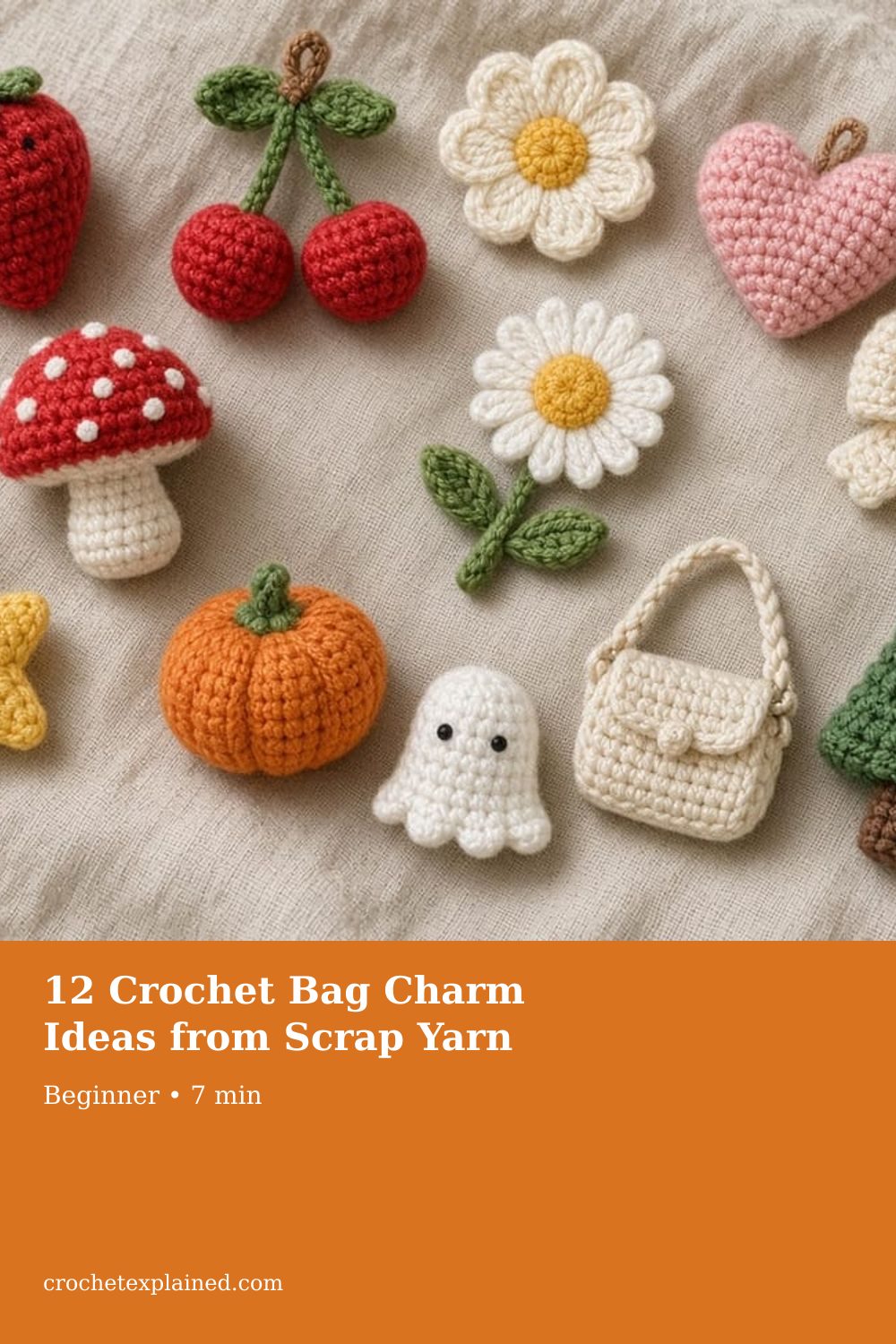
12 Crochet Bag Charm Ideas from Scrap Yarn
Only the tiny heart is a full stitch pattern. The other eleven shapes are scrap-yarn ideas, and the loop has to be thick enough that a zipper pull does not saw through it.
Twelve scrap-yarn bag charm ideas, plus one complete tiny heart pattern in US terms. The other shapes are ideas, not full patterns.
At a glance
- Skill level
- beginner
- Time
- See the pattern
- Finished size
- Estimated in the pattern
- Yarn weight
- See the pattern
- Hook size
- See the pattern
- Yardage
- Estimated in the pattern
On this page
US crochet terms throughout. Sizes here are worked out from gauge rather than from a finished sample, so swatch and measure as you go, and the pictures of finished pieces are illustrations. Made one? Send a photo through the contact page.
A bag charm is a scrap project that has to survive a zipper pull. If the loop is thin, it saws through in a week. If the charm is heavy, it knocks the bag while you walk.
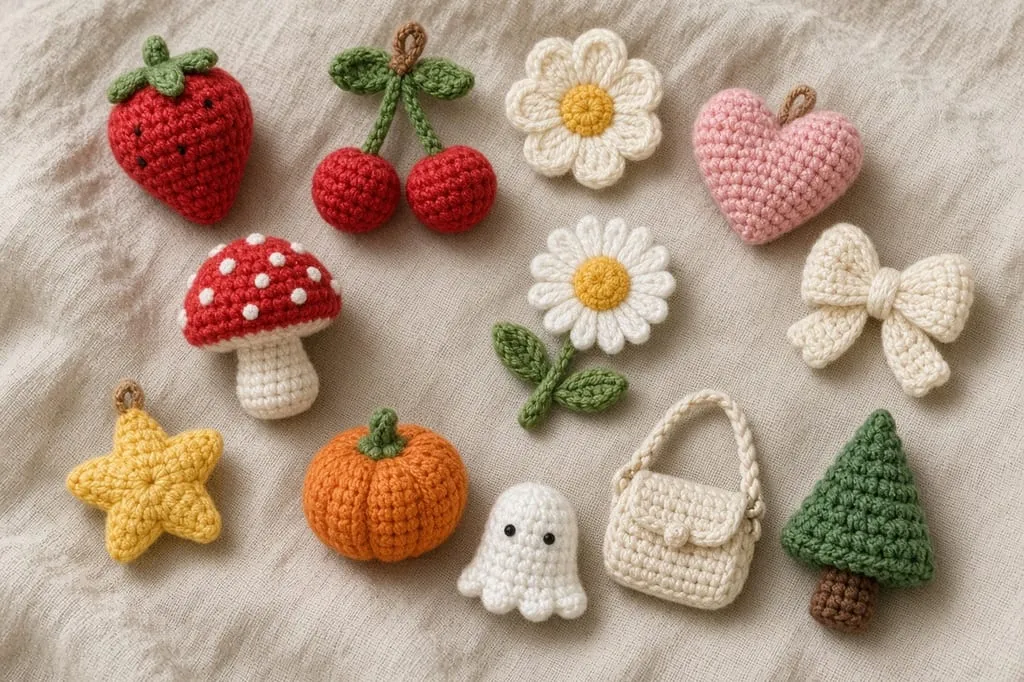
Below are 12 shapes worth making from leftover worsted cotton. Only the tiny heart has a full stitch pattern. The other eleven are ideas: color, size, and what to watch. They are not tutorials. Do not treat the group photo as proof that each shape has been written out. The loop that goes on a zipper should be a short chain of the same cotton as the charm, closed with a slip stitch, and thick enough that it does not saw through. Test the loop on the zipper pull before you weave the end. A loop that barely fits will cut itself.
US terms. Photos are illustrations. The heart has not been physically tested.
Shared rules
- Cotton scraps. Worsted makes a charm of about 2 inches. Sport or fingering weight with a smaller hook makes a smaller one. Amounts have not been weighed. Yarn weights.
- A hook a size smaller than the label suggests, so the fabric stays firm. Hook chart.
- A split ring, plus a chain of about 12 stitches sewn on as the loop.
- Stuff very lightly, or not at all. Keep a charm small and light, about 2 inches or less, so it does not knock against the bag.
Sew the loop to a solid part of the charm, weave the tail through the chain three times, and clip the ring on after. Do not crochet around the metal.
The twelve
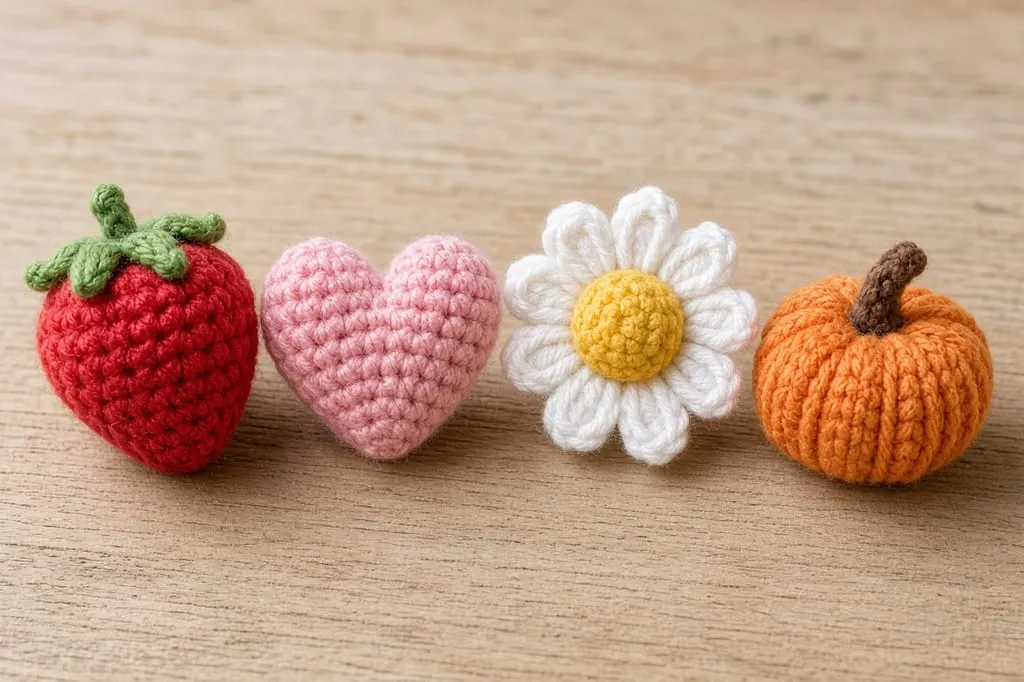
Strawberry. Red body, green cap. Beginner if you already make small balls. The seeds are embroidered after, with shallow stitches, so the back stays flat against a bag.
Cherry. Two tiny red balls and a green chain stem. The stem is the weak point. Chain it a little thicker by holding two strands, or it kinks and snaps.
Mini flower. Five petals around a small center. A full-size flower with a different construction is how to crochet a simple flower. That pattern is not a charm. Scale is the whole problem: a flower that looks right at 4 inches looks sparse at 1 inch.
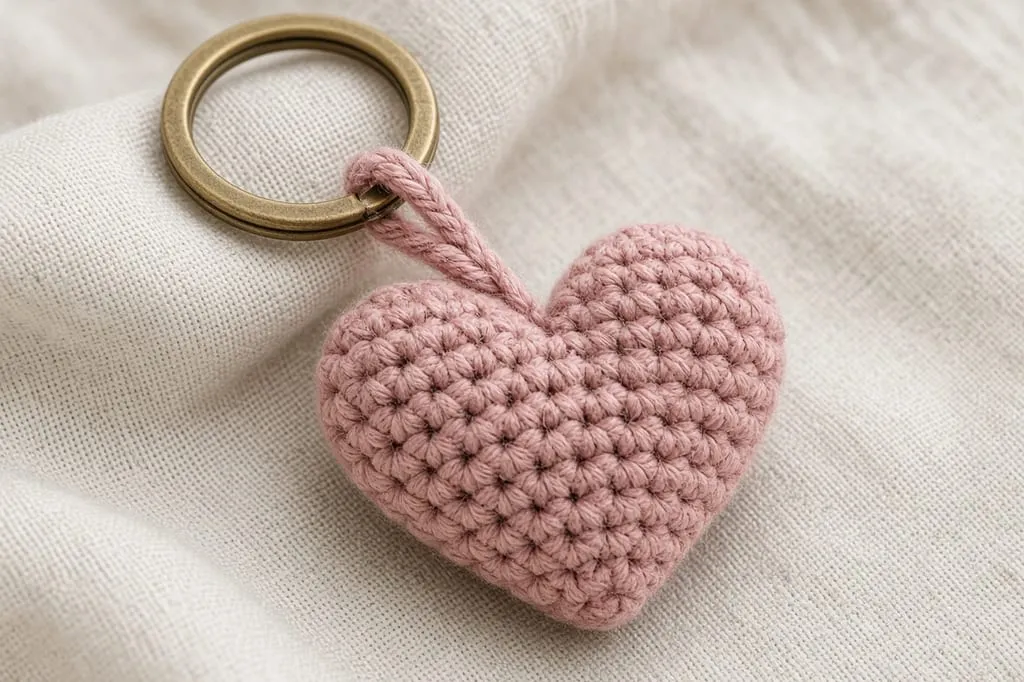
Tiny heart. Full pattern below. Beginner. Rows, then two short lobes.
Bow. Two loops and a center wrap. Intermediate only because the tails twist. Pin the loops before you wrap the center or the bow collapses into a knot.
Mini mushroom. A short white stem and a red cap. Beginner shapes, fiddly sewing. The cap wants to slide off a skinny stem. Sew through the center, not just the edge.
Daisy. White petals, yellow center. Same warning as the mini flower. Keep petal counts low or the charm becomes a disk.
Star. Five points. The three-round flat star in Christmas ornament ideas works as a charm in a thinner yarn. Stiffen it lightly or the points flop.
Pumpkin. Orange ball, brown seam lines, short stem. A stuffed pumpkin with a full write-up is how to crochet a pumpkin. Use that if you want a bowl-sized pumpkin. A charm is the same idea at scrap size, and it is not written out here.
Mini ghost. White blob and two embroidered eyes. A pouch-sized ghost with a drawstring is a drawstring bag with a face. A charm has no opening.
Tiny purse. A flat rectangle folded and seamed, with a strap of chain. Beginner. It is a charm, not a coin purse. Do not expect it to hold anything.
Mini Christmas tree. Green triangle, small trunk. A standing tree pattern is how to crochet a Christmas tree. That one is an ornament-scale project, not this charm.
Tiny heart pattern
Work in rows. Ch 1 at the end of a row does not count as a stitch.
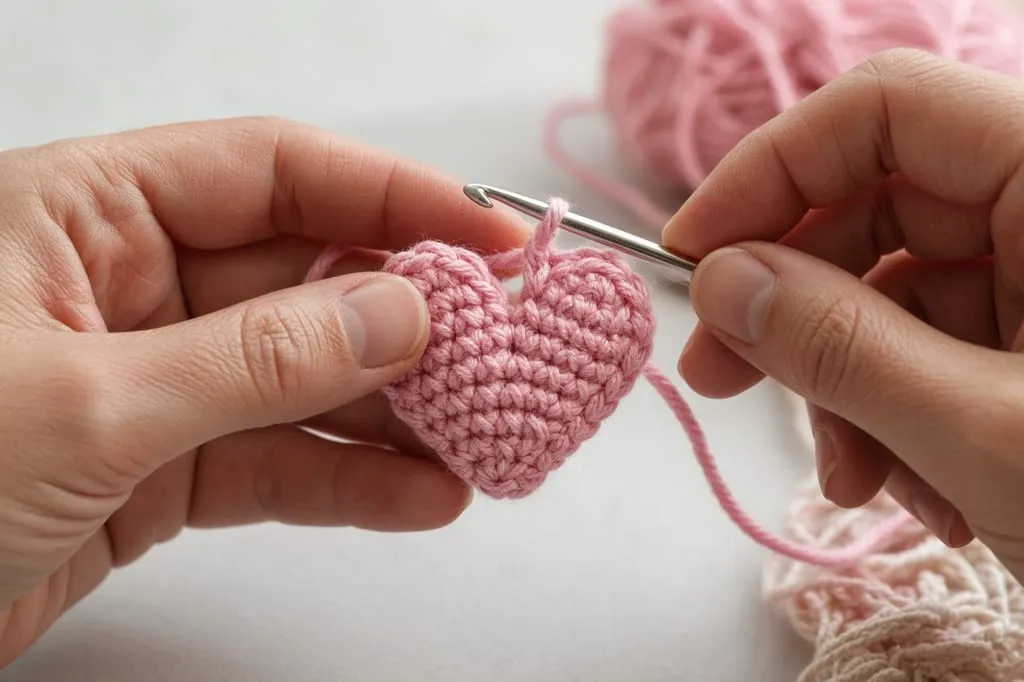
Chain 2.
Row 1: sc in the 2nd chain from the hook. Ch 1, turn. (1)
Row 2: inc. Ch 1, turn. (2)
Row 3: inc in each stitch. Ch 1, turn. (4)
Row 4: inc, sc 2, inc. Ch 1, turn. (6)
Row 5: inc, sc 4, inc. Ch 1, turn. (8)
Row 6: sc in each stitch. Ch 1, turn. (8)
Row 7, first lobe: sc in the next 4 stitches. Ch 1, turn. Leave the other 4 unworked. (4)
Row 8: dec, dec. (2)
Fasten off.
Second lobe: join the yarn in the first unworked stitch of Row 6. Sc in that stitch and the next 3. Ch 1, turn. (4)
Next row: dec, dec. (2)
Fasten off. Weave the ends.
Row 5 is 8 because 6 stitches plus 2 increases equal 8. Each lobe takes 4 of those 8. Two decreases on 4 stitches equal 2.
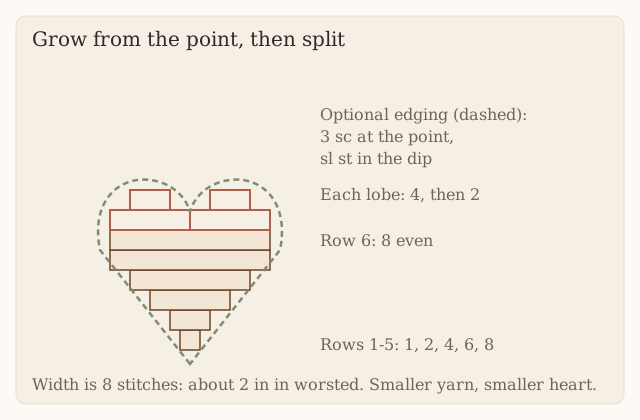
Edging (optional). The rows leave a stepped outline. To smooth it, join yarn at the bottom point and sc evenly all the way around, one sc in each row end and each stitch, 3 sc in the bottom point, and a sl st into the dip between the lobes. Join to the first sc and fasten off. The edging adds a stitch of width all round.
At 4 sc to the inch, 8 stitches are about 2 inches across, a little more with the edging. For a smaller charm, use a thinner yarn and hook rather than fewer rows. Fewer rows change the shape.
Chain 12 for the hanger. Sew both ends between the lobes, on the back, so the point hangs down.
On the bag
One charm on a zipper is enough. Three on the same pull tangle. If you want a set, use separate rings on separate hardware.
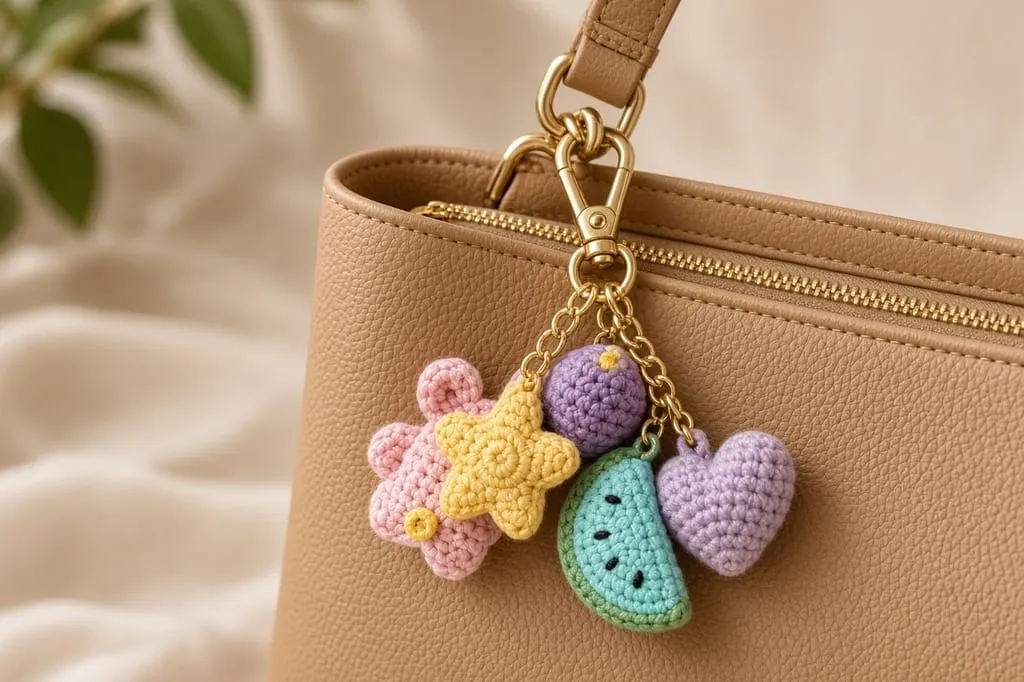
Complete one heart before making a set
For the heart, inc means two sc into one stitch and dec means sc2tog. Body counts are 1, 2, 4, 6, 8, 8. On row 7, work only four stitches, turn and decrease twice; the other four body stitches must remain untouched for the second lobe. Mark that first unworked stitch before fastening off. The lobes finish at two stitches each. After weaving tails, sew a reinforced hanger through several stitches on the back between the lobes, keeping the center dip visible. Test with the charm alone. The other listed shapes remain ideas, not eleven additional complete patterns.
Mistakes
A loop of one strand. It wears through. Use the chain, then sew it down so the ring cannot saw one fiber.
Copying a designer’s charm from a photo. A shape idea is not a license to redraw someone else’s pattern. The heart above is the pattern on this page. For the rest, write your own counts or use a project you already have the rights to make.
Heavy stuffing. The charm should not thunk against the bag.
Wash a new charm before it lives on a pale bag. Cotton can still drop a little dye, especially red and orange. Rinse it, let it dry, and then clip it on.
Care
Take the ring off. Hand wash cool. Dry flat. Do not iron. A pressed heart becomes a felted lump if the yarn is wool. Cotton is the safer scrap.
Frequently asked
Are all 12 patterns on this page?
No. The heart is complete. The list is there so you can pick a scrap project and see the attachment method. A missing pattern is not an invitation to invent stitch counts and call them tested.
Can I sell the hearts?
Finished hearts, yes. Do not republish the row instructions.
What yarn should I avoid?
Eyelash and mohair. The shape disappears, and the loop grabs every sweater you walk past.
Next
A useful scrap that is not a charm is the lip-balm holder in the device case guide. If you want a Halloween piece that holds something, use a drawstring treat bag instead of a mini pumpkin charm.
- bag charm
- scrap yarn
- beginner
- heart
Read this next
- How to Crochet a Christmas Tree Garlic Holder A small mesh garlic holder with scalloped branches, a gold star, and an open top. US terms. Sizes are design targets.
- How to Crochet a Christmas Tree Plastic Bag Holder Crochet a hollow Christmas tree that holds grocery bags. Bags go in the open top and out the brown trunk. US terms. Sizes come from gauge.
- How to Crochet a Compact No-Slip Kitchen Towel Holder A compact cotton crochet towel holder with two wooden rings, one above the other. Assembly counts are still being checked. US terms.