
Left-Handed Crochet: How to Follow Any Pattern
Almost every crochet tutorial is filmed right-handed. Here is how to mirror patterns, diagrams and videos so you can follow any of them left-handed.
Roughly one person in ten is left-handed, and almost every crochet tutorial ever made is filmed right-handed. Older instruction books used to tell left-handers to trace the diagrams onto paper and hold the tracing up backwards.
You can do considerably better than that. Here is how to follow any pattern, diagram, or video left-handed without translating anything by hand.
The good news first
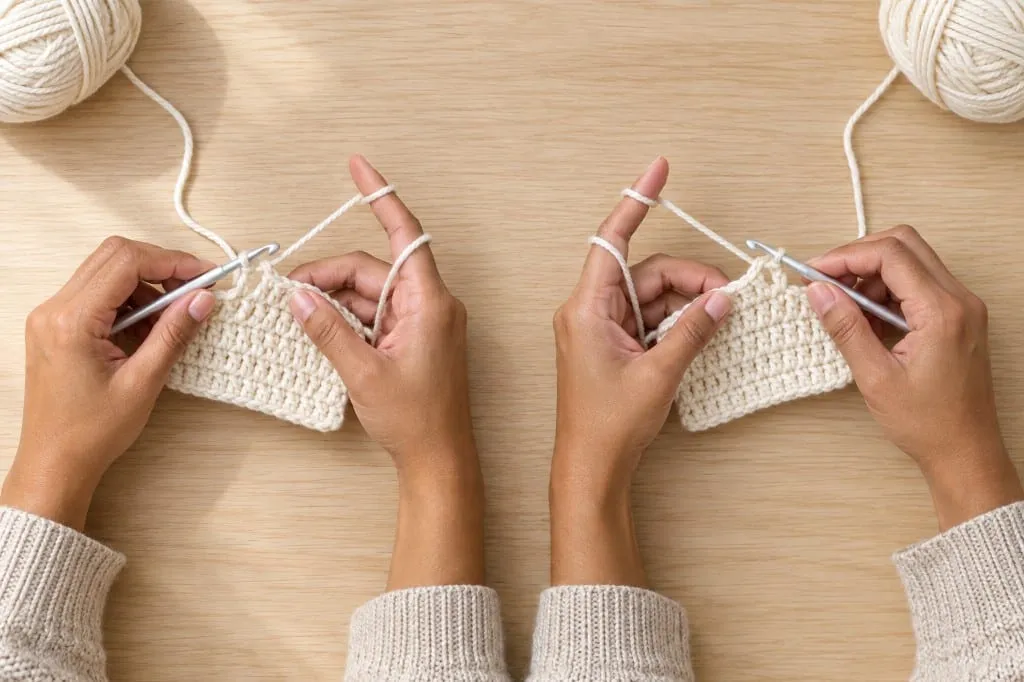
Crochet is not a handed craft the way writing is. Both hands work the whole time: one holds the hook and one manages the tension and the fabric. Left-handed crochet is a genuine mirror image of right-handed crochet, and every stitch, every pattern, and every technique works identically. Nothing is off limits and nothing is harder.
There are only three real differences, and they are all mechanical.
Difference 1: you work in the opposite direction
Right-handers work a row from right to left. You work from left to right.
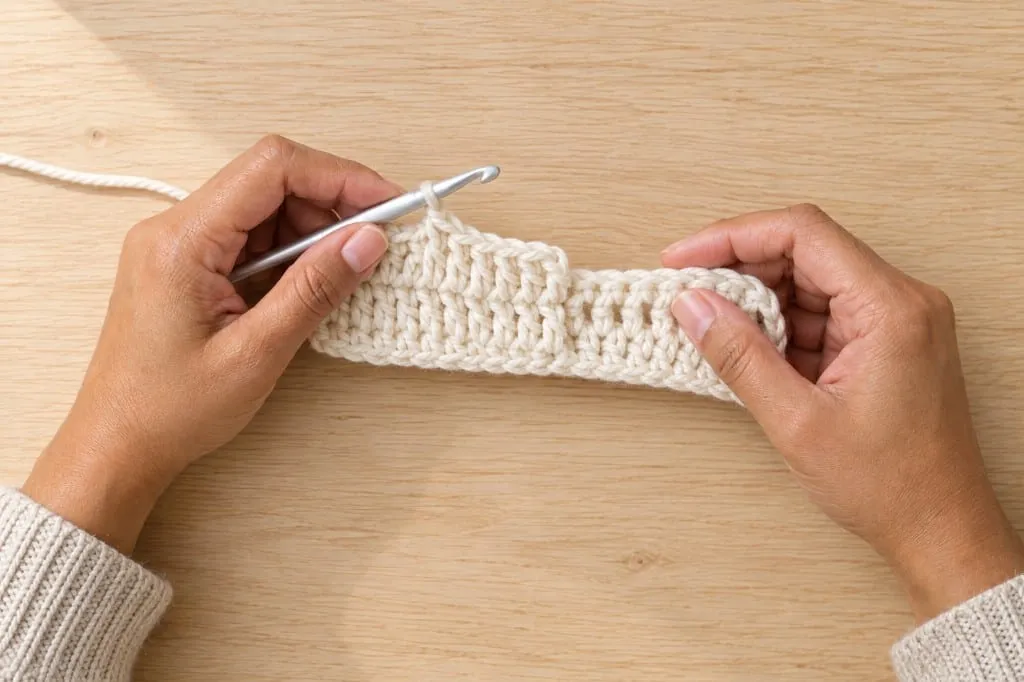
That is the entire change for flat work in rows. Chain, turn, work back the other way. Your stitches are identical, your fabric is identical, and your finished piece is identical.
In the round, right-handers work counterclockwise. You work clockwise. Again, the result is the same object.
Difference 2: written patterns say “right” and “left”
When a pattern gives a direction, swap it. Every time it says right, read left, and vice versa.
This matters in exactly three situations, and is irrelevant everywhere else:
- Shaping instructions in garments — “work to the right front edge” needs swapping.
- Directional colorwork or motifs — anything where the design has a definite left and right.
- Anything asymmetric — a cardigan’s buttonband, a bag’s side pocket, an animal’s ears if they differ.
For a scarf, a blanket, a hat, a dishcloth, a granny square, or a plain amigurumi body, there is nothing to swap. The overwhelming majority of beginner patterns need no translation at all.
Before starting a garment, read the pattern through once with a pencil and swap every left and right as you go. Ten minutes up front, and you never have to think about it again while your hands are busy.
Difference 3: your fabric is a mirror image
Your finished piece is the mirror of the photograph in the pattern.
For nearly everything, this is invisible and irrelevant — a mirror-image granny square is a granny square. It becomes visible in two cases:
Directional stitch patterns. Anything that leans, spirals, or slants — chevrons, spike stitches, some cables — will lean the other way. Usually this looks perfectly good and nobody but you will notice.
Written text and lettering. If you are crocheting letters or a graphgan with words, they will come out backwards. For these, read the chart from the opposite side: where a right-hander reads a right-side row from right to left, you read it from left to right.
How to use right-handed videos
This is the practical problem, and there are three solutions that all work better than tracing paper.
1. Search for left-handed tutorials directly. Add “left handed” to any search. There is now a substantial body of left-handed crochet instruction on YouTube — entire channels dedicated to it — that did not exist when those old booklets were written. For any basic technique, a left-handed version exists.
2. Mirror the video on your device. Many video players and phone apps can flip playback horizontally, which turns any right-handed tutorial into a left-handed one instantly. On a desktop, browser extensions do this for streaming video in one click. This is the single most useful trick in this article, and it works for every tutorial ever filmed.
3. Use an actual mirror. Prop a mirror beside your screen and watch the reflection. Low-tech, free, works immediately, and is how left-handers managed for decades.
Do not bother learning to mirror the movements in your head while also learning the stitch. Flip the video and learn the stitch once.
Reading stitch diagrams
Stitch diagrams — the symbol charts common in lace and Japanese patterns — are read bottom to top by everyone. The horizontal direction is what changes.
| Right-handed | Left-handed | |
|---|---|---|
| Right-side rows | right to left | left to right |
| Wrong-side rows | left to right | right to left |
| Rounds | counterclockwise | clockwise |
Circular motif diagrams need nothing at all if the motif is symmetrical, which most are.
Should you just learn right-handed?
Some left-handers do, and it genuinely works for a fair number of people — because both hands are already working, the hook hand is doing less fine motor work than you might assume. If you have a right-handed friend or relative teaching you in person, learning their way can be the path of least resistance.
But do not force it. If it feels wrong after a few sessions, switch. Working left-handed costs you nothing except occasionally flipping a video, and a craft you resent is a craft you quit.
Practical notes
Hooks are symmetrical. Standard aluminum and plastic hooks work identically in either hand, so there is nothing special to buy. The one exception is some ergonomic handles with a thumb rest shaped for a specific grip — check that the rest is symmetrical, or use a plain hook.
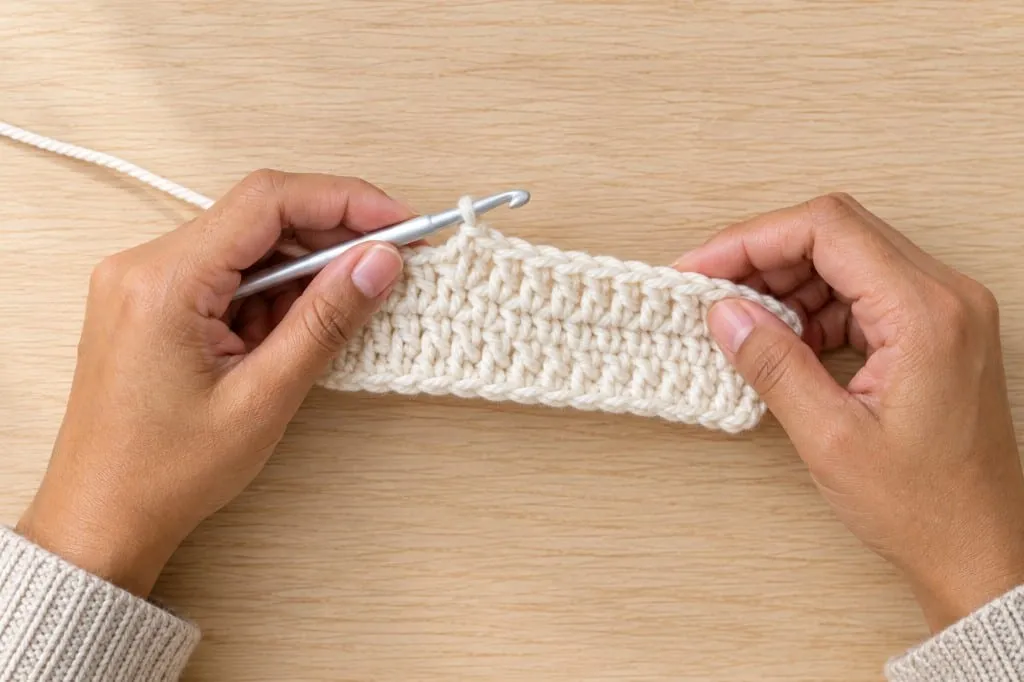
Seaming and joining are unaffected. Whipstitching, slip stitch joins, and weaving in ends have no handedness.
Gauge swatches are unaffected. Your gauge is your gauge. Nothing about being left-handed changes how gauge works or how to measure it.
Frequently asked
Will my stitches look different from the pattern photo? Only mirrored, and only visibly so on directional stitch patterns. The fabric quality, tension, and structure are identical.
Can I work on a project a right-hander started? Yes. You will be working in the opposite direction from them, but the stitches you meet are the same stitches. Collaborative blankets get made this way all the time.
Are there left-handed patterns? A few designers publish them, but you do not need them. Standard patterns work with the swaps above, and for most beginner projects there is nothing to swap.
Why did old books tell me to trace the diagrams? Because printing two sets of diagrams doubled the page count, and mirroring a video was not possible in 1990. It was a genuine constraint then. It is not one now.
- left handed
- beginner
- patterns
- accessibility